
What if the next patron could start with the same approved computer setup, without staff rebuilding it after every session? That’s the practical goal of library public pc restore software: users may change settings or leave unwanted files behind, while staff need a predictable way to return shared workstations to a known baseline.
A reboot-to-restore approach makes the restart part of the routine. Once a library establishes an approved configuration, the software returns the computer to that baseline when it restarts. Planned maintenance still matters: staff need to apply and preserve approved updates and library settings so routine restoration doesn’t undo them.
This article presents a practical evaluation framework, not a report of a named library deployment or measured results. It explains how to set a baseline, handle updates, and build restoration into the session cycle. It also covers when centralized management may help across networked PCs, including how Reboot Restore Enterprise fits that environment. The aim is a consistent user experience and a repeatable process for IT staff.
Key Takeaways
- Match public computer session needs to a restore routine that supports a consistent shared environment.
- Assess how library public pc restore software could fit into a restart-based workstation routine.
- Evaluate a case study using documented observations, not invented customer details or assumed results.
- Plan baseline settings, pilot scope, maintenance, staff communication, and review before making restoration part of daily operations.
- Distinguish between resetting shared PCs on restart and system-level rollback, then consider whether centralized management suits a networked environment.
Why library public PCs need a reliable restore routine
Public library computers support a changing stream of users and tasks. One person may browse a catalog, another may complete an online form, and someone else may use a word processor. Between sessions, each workstation still needs to present a familiar, library-managed environment. Depending on how computers are used, staff may also need to account for changed settings, downloaded items, or accidental configuration changes. These are possibilities to plan for, not incidents every library will experience.
A reliable restore routine gives staff a defined way to return shared computers to an approved state. The library decides what that state includes, such as selected applications, system settings, and access shortcuts. Defining that boundary helps distinguish temporary session activity from software and configuration the library deliberately maintains.
What can change between public library sessions?
During a session, a user might alter a display preference, save a file locally, or download an item. Someone could also change a setting unintentionally while completing a task. If those changes remain, they may affect the next person’s experience or make troubleshooting less straightforward.
Before using library public pc restore software, separate session activity from approved workstation content. Library policy should specify where users may save work and which settings or applications belong in the managed configuration. A restart-based restore can return a computer to its baseline, but it doesn’t determine whether a change was harmless, identify who made it, or detect a threat. Those responsibilities require separate processes and controls.
What does a stable public workstation make easier?
A known configuration gives staff a consistent reference point. If a user reports that an application behaves differently, staff can compare the workstation with its intended setup rather than first working out what may have changed during earlier sessions. This can make support conversations and routine troubleshooting more predictable, though it can’t prevent every technical issue or guarantee uninterrupted access.
An approved workstation baseline is the library-managed configuration intended to support normal public use. Defining it clearly helps staff distinguish a temporary user change from an update the library wants to retain. It also makes maintenance decisions more deliberate: an approved application change should be incorporated into the managed setup, rather than treated like disposable session activity.
Restore software is one part of endpoint management, not a complete security or data-protection strategy. Libraries still need appropriate security controls, such as access restrictions and protective software suited to their environment. A restore routine also isn’t a backup and shouldn’t be treated as a way to preserve patrons’ files or recover important data. Clear saving guidance, separate backup practices, and a documented workstation baseline address different operational needs.
With those boundaries in place, staff can plan a routine around how public terminals are used. The goal isn’t to assume every session creates a problem. It’s to define the expected workstation state and give the library a repeatable way to maintain it between users.
How reboot-to-restore software resets a library PC
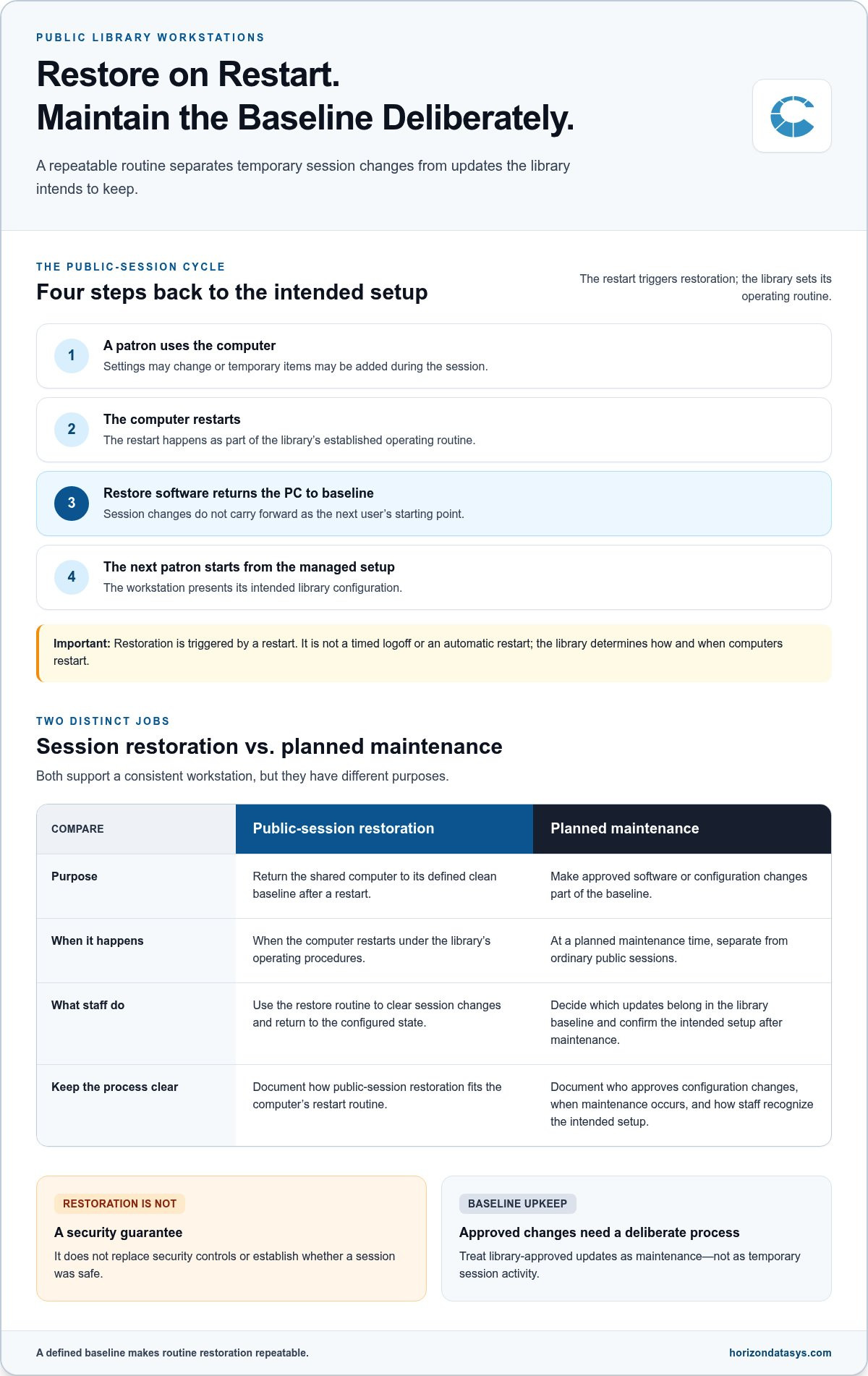
Reboot-to-restore software is designed to return a computer to a defined clean baseline when it restarts. Changes may occur during public use; the restart triggers restoration so the next user can begin from the configured state. This gives library staff a repeatable operating pattern without requiring them to identify and reverse every change individually.
The sequence is straightforward:
- A patron uses the public computer and may change settings or add temporary items during the session.
- The computer restarts as part of the library’s established operating routine.
- The restore software returns the shared workstation to its clean baseline.
- The next patron begins with the intended library-managed configuration.
This describes restoration on restart, not a timed logoff or an automatic restart. The library determines how and when computers restart within its operating procedures. For a closer look at the underlying mechanism, see how reboot-to-restore software works.
What happens at the end of a public session?
The restart is the trigger. Once it occurs, the configured restore process returns the computer to its baseline instead of carrying session changes forward as the next user’s starting point. That consistency can make shared PCs easier to prepare for recurring use. It isn’t a security guarantee: restoration doesn’t replace security controls or establish whether a particular session was safe.
How is routine maintenance handled?
Approved software or configuration changes need a planned maintenance process. Administrators should distinguish that work from ordinary public sessions, decide which updates belong in the library’s baseline, and confirm the intended configuration after maintenance. This keeps changes the library wants to retain from being treated like temporary session activity and later cleared by routine restoration.
Make the workflow clear by documenting who approves configuration changes, when maintenance takes place, and how staff recognize the intended setup. Public-session restoration and system maintenance serve different purposes: one resets the computer to its managed baseline; the other updates that baseline deliberately. The procedure should fit the library’s existing change practices rather than assume every workstation is maintained in the same way.
Reboot-to-restore resets a computer’s configured state; file backup preserves data for recovery. A reset routine shouldn’t be treated as a way to retain patrons’ documents or recover important files. Saving guidance and backup practices should remain separate parts of the library’s operating plan.
For libraries evaluating library public pc restore software, Reboot Restore Standard and Reboot Restore Enterprise return shared computers to a clean baseline upon restart. Enterprise adds centralized management tools for network environments. Reviewing Reboot Restore options can help frame which approach aligns with the library’s workstation management needs.
What a library restore-software case study should evaluate
A useful case study begins with an operational question, not a dramatic incident: how does a library keep shared PCs aligned with its approved configuration, and what work does that process require from staff? An example can be representative without naming a customer or implying that a particular library experienced specific problems. Its value comes from showing what was evaluated, how observations were gathered, and which conclusions the evidence can support.
Before comparing results, define the workstation group, restore workflow, and observation period. Compare the new process with a documented baseline, such as the library’s existing method for returning computers to approved configurations. Without consistent definitions, a change in support requests or staff effort may reflect different procedures or reporting practices rather than the restore approach itself.
Which operational measures are useful?
Choose measures tied to the library’s goals. To assess restoration consistency, record whether reviewed PCs return to the intended setup after restart. To understand support demand, count relevant workstation issues using an agreed category. To assess staff effort, track time spent restoring approved configurations and define which tasks count. Set the collection period, baseline, and recording method before interpreting any difference.
Operational goal | Observable measure | Evidence source
Consistent starting state | Whether reviewed PCs match the approved setup after restart | Documented workstation checks against the baseline
Understand support demand | Number of relevant public-PC support requests in a defined period | Consistently categorized support records
Assess staff workload | Time spent returning PCs to approved configurations | Maintenance notes or time records using the same task definition
This framework helps a library evaluate library public pc restore software without presenting estimates as results. If records don’t exist, establish a collection process first. Don’t fill gaps with assumed savings or unsupported percentages. Broader evaluation criteria, including how to compare shared-computer protection needs, are covered in this shared computer protection buying guide.
How can a case study maintain credibility?
Describe the environment and workflow only with the library’s authorization, and include enough context to make the process understandable without exposing sensitive details. Keep observed outcomes separate from expected benefits and product capabilities. A capability explains what software is designed to do; it doesn’t by itself prove a local operational improvement.
Case-study results depend on documented local evidence. Report what was measured, how the baseline was established, and any limits in the records. If no before-and-after evidence is available, present the material as a proposed evaluation framework, not as a completed case study or a claim of measured results.
Plan a practical restore workflow for public library computers
A dependable workflow starts with decisions, not software settings. Staff need to know what each public workstation should contain, what users may save, and how approved changes will be maintained. This preparation makes library public pc restore software part of a clear operating routine rather than an isolated technical change.
Define the baseline and pilot
Document the approved operating-system and application configuration before enabling routine restoration. Include the settings and resources needed for normal public use, and distinguish them from temporary session activity. Then choose a limited, representative group of public computers for a pilot. Before it begins, record the expected user experience, staff responsibilities, and how the library will identify and report issues.
Library policy should explain what users may save and where approved work belongs. If local files or session changes may be cleared during restoration, patrons need clear guidance on appropriate save locations and what to expect at restart. Base the workflow on actual library policy rather than assuming every terminal has the same purpose or configuration.
Coordinate maintenance and review
Handle approved changes through the library’s established maintenance process. Decide who authorizes updates, how changes are incorporated into the intended configuration, and how staff will verify the workstation afterward. Keep this work separate from normal public use, then review restoration behavior and support records against measures defined before the pilot. Update staff guidance whenever the workflow or approved setup changes.
Shared devices in other environments raise related planning questions. The school computer lab rollback best practices offer a related perspective on maintaining consistent endpoints, while a library’s own policies and public-service needs should guide its workflow.
Adapt this checklist to the library’s setup:
- Document the approved system and application configuration for each workstation type.
- Define what patrons may save, where approved work belongs, and what restoration may clear.
- Select a limited pilot group that reflects the library’s public-computing use.
- Write down staff roles, patron-facing guidance, and the expected session experience.
- Schedule configuration changes through the established maintenance process.
- Review restoration behavior and relevant support records, then revise guidance as needed.
This measured rollout gives staff a basis for deciding whether to expand the workflow and what needs adjustment first. To explore how Reboot Restore supports a restart-based approach, review Reboot Restore solutions.
Choose a library PC restore approach that fits daily operations
The right approach depends on the job the library needs done. Is the priority returning shared terminals to a consistent state after restart, or rolling a system back to address a broader system-level issue? These are related endpoint resilience needs, but they aren’t interchangeable. Matching the method to the operational requirement helps staff choose a workflow they can explain and maintain.
When does reboot-to-restore fit shared library PCs?
For recurring public sessions, Reboot Restore Standard returns shared computers to a clean baseline upon restart. It fits an environment where the routine objective is to give each user the library-approved starting configuration. Reboot Restore Enterprise provides the same restart-based restoration and adds centralized management tools for network environments, making it relevant when a library manages computers across a network.
As you assess library public pc restore software, focus on the desired reset point and how staff manage the workstations. Consider which PCs should return to a baseline, how approved changes will be maintained, and whether centralized management is relevant to the environment. Ground the evaluation in those needs rather than assuming every library has the same operating model.
How is system rollback a different need?
RollBack Rx uses sector-level snapshots for rapid system rollback. That approach addresses recovery to a previous system state, while Reboot Restore is designed to return shared computers to a clean baseline upon restart. In practical terms, one supports a planned reset between public-use sessions; the other provides a distinct rollback approach for system recovery.
Choose according to the scenario you need to address:
- Recurring shared use: Consider reboot-to-restore when the desired routine is to reset a public PC to its clean baseline on restart.
- Networked workstation management: Consider Reboot Restore Enterprise when centralized management is relevant across networked computers.
- System rollback: Consider RollBack Rx when the need is sector-level snapshot-based rollback rather than session-by-session restoration.
These approaches don’t replace backups, antivirus, or other security measures. A baseline reset, a system rollback, data protection, and threat prevention serve different purposes. Libraries should account for each need in their broader endpoint practices and avoid treating one recovery method as a complete protection plan.
Start with the operational question, then align the tool and staff workflow to it. For public terminals with repeated sessions, restart-based restoration may fit; for network environments, centralized management may matter; and system rollback serves a different recovery need. Explore Horizon DataSys restore solutions to review the available approaches for shared and Windows endpoint environments.
Make the next step a clear operational decision
A restore workflow works best when it reflects how your library serves the public. Use documented observations to decide what needs attention next: clarify patron guidance, refine staff procedures, or extend a tested approach to more workstations. This keeps library public pc restore software aligned with the library’s priorities rather than treating deployment as an end in itself.
Before changing the workflow, bring relevant staff together around one practical question: what should the next patron encounter, and what steps will help staff maintain that experience? A shared answer can guide future reviews as public services, approved configurations, and support needs evolve.
With a clear operational goal in view, explore the options that can support your environment. Explore Horizon DataSys restore solutions and consider which approach fits your library’s next step.
Frequently Asked Questions
What is library public PC restore software, and how does it work?
Library public PC restore software returns a shared computer to its approved configuration when it restarts. For example, if a patron changes a desktop preference or leaves a downloaded item, the restart-based process returns the workstation to its configured baseline. The library defines and maintains that baseline; the software doesn’t determine which changes were appropriate. Reboot Restore Standard and Reboot Restore Enterprise are designed to restore shared computers this way.
Does reboot-to-restore software remove changes after every library user?
It restores the computer when a restart occurs, so changes aren’t necessarily cleared as soon as one patron finishes. If a workstation remains running between users, session changes may remain until it restarts. The library’s operating procedures should make clear when restarts take place and what patrons should expect. Don’t promise an immediate reset after each session unless the library’s workflow includes a restart at that point.
Can a library preserve approved updates while restoring public computers?
Yes. Administrators can treat approved updates as planned maintenance and incorporate them into the configuration the library intends to retain. For example, before an application change becomes part of the normal workstation setup, staff can document the change and confirm the desired configuration after maintenance. This separates intentional library updates from temporary session activity, helping ensure routine restoration doesn’t undo changes the library has approved.
Is reboot-to-restore software a replacement for backup or endpoint security?
No. Reboot-to-restore returns a computer to its configured state on restart; it isn’t a method for preserving files a patron or staff member needs later. Nor should it be treated as antivirus or as a complete security program. Libraries should maintain separate practices for protecting important data and securing endpoints. Clear patron instructions about where work can be saved can also reduce confusion about files that may not persist.
How should a library measure whether PC restore software is helping?
Start with a simple review record that distinguishes restoration-related issues from unrelated computer questions. Staff can note whether a workstation returns to its intended setup, describe any exceptions, and record what follow-up was needed. Use the same definitions throughout the review so entries remain comparable. A brief staff check-in can add context, such as whether the procedure is clear or patron instructions need revision.
Can Reboot Restore Enterprise manage multiple library computers?
Yes. Reboot Restore Enterprise includes centralized management tools for network environments, making it relevant to libraries managing multiple networked PCs. A practical evaluation can begin by identifying which computers share an approved configuration and which may need different setups. That distinction helps the library plan workstation groups and staff procedures without assuming every public computer serves the same purpose.
What is the difference between Reboot Restore and RollBack Rx?
Reboot Restore returns shared computers to a clean baseline upon restart, which suits recurring public-use sessions. RollBack Rx uses sector-level snapshots for rapid system rollback, addressing a different recovery need. One approach focuses on restoring the expected workstation state as part of shared-computer use; the other provides rollback to a snapshot. Libraries should choose based on the operational scenario, not treat the products as interchangeable.