
To eliminate helpdesk tickets shared PCs keep generating, prevent one user’s session changes from becoming the next user’s problem. On shared workstations, unwanted settings, software changes, and configuration drift can make familiar issues return, while staff spend time restoring a setup that should already be consistent.
A clean reboot baseline can help break that cycle. Reboot-to-restore software returns a PC to its established baseline when it restarts, reducing repeat issues caused by changes made during a session. It isn’t a universal helpdesk replacement: account access, network outages, printer faults, hardware failures, and problems already present in the baseline need separate troubleshooting or controls.
This article explains which recurring shared-PC issues a reboot baseline can prevent, where its limits begin, and how to assess a ticket before choosing a response. You’ll also see how Reboot Restore Standard and Reboot Restore Enterprise fit this approach. Enterprise includes centralized management tools for network environments. The aim is a more predictable starting point between users and fewer avoidable support tasks.
Key Takeaways
- Group recurring tickets by cause, such as local settings, software changes, account access, or peripherals, before selecting a fix.
- Trace how a user’s activity changes workstation state and leads to the next person reporting an issue.
- Define the intended PC setup and document which changes should persist between sessions to make troubleshooting more consistent.
- Use reboot-to-restore to help eliminate helpdesk tickets shared PCs generate from unwanted session changes, while directing unrelated faults to the right controls.
- Compare Reboot Restore Standard and Enterprise as clean-baseline options. Enterprise includes centralized management tools for network environments.
Why Shared PCs Generate Repeat Helpdesk Tickets
The user changes, but the same endpoint issue returns. One person adjusts a setting or installs an unapproved utility; the next person signs in and finds the workstation behaving differently. IT restores the expected setup, but if the condition that allowed the change remains, another session can recreate the problem. That cycle is a common operational challenge with shared PCs.
Recurring tickets tied to workstation state often fall into three related groups:
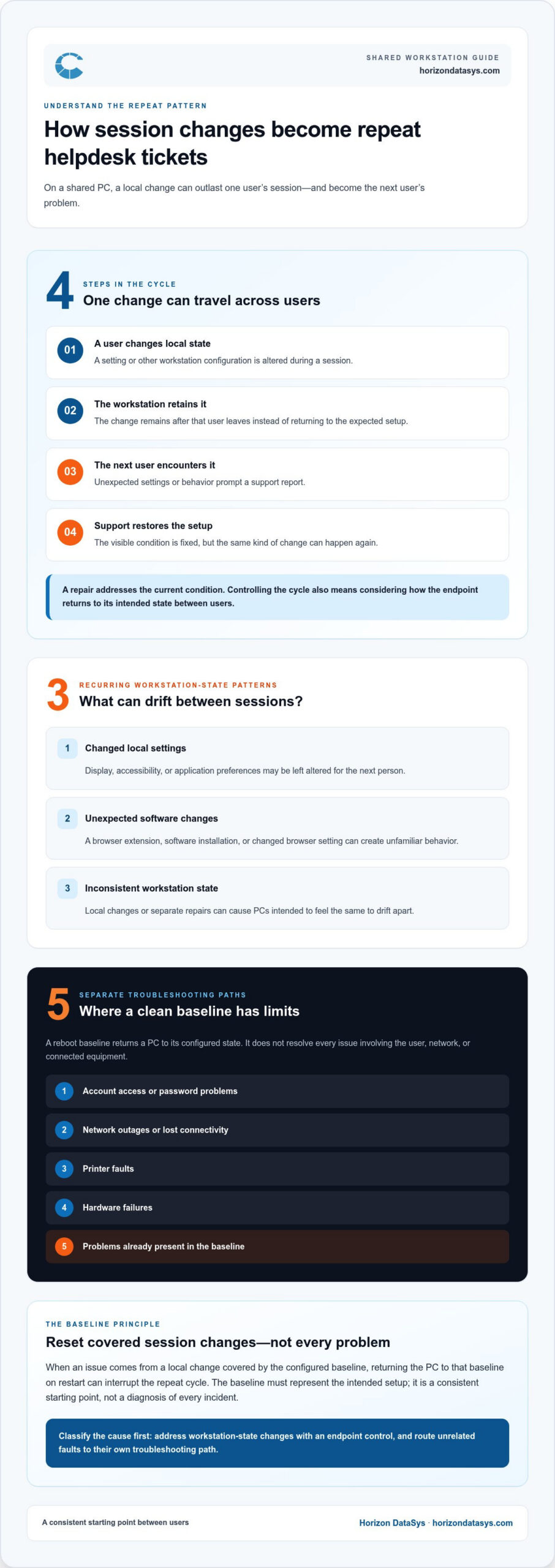
- Changed local settings: Display, accessibility, or application preferences may be altered and left in place for the next user.
- Unexpected software changes: A user may add a browser extension, install software, or change browser settings, creating unfamiliar behavior afterward.
- Inconsistent workstation state: PCs intended to provide the same experience can drift apart as different users make local changes or staff repair each machine separately.
Distinguish these patterns from incidents with other causes. Account or password problems, network outages, printer faults, and hardware failures call for their own diagnosis and controls. Don’t automatically blame the previous user for a slow-computer or missing-file report. Performance problems and file access can have causes unrelated to a session change.
Which repeat issues are specific to shared workstations?
Shared use makes local changes harder to trace. If several people use a PC between checks, staff may not know who changed a browser preference or when an unexpected configuration appeared. That doesn’t establish who is responsible; it shows why the endpoint needs a clearly defined expected state. The idea behind reboot-to-restore software is to return a computer to a chosen baseline after a restart, rather than rely on each user to leave it unchanged.
Why do the same tickets return after a fix?
A one-time repair addresses the visible symptom: support restores a setting, removes an unwanted change, or returns an application to its expected configuration. But if users can make the same change again and the endpoint keeps it, the next session may produce the same report. A lasting response considers both the repair and the process that lets the problem recur.
A repeat ticket on a shared PC reports a condition that one session leaves behind for another user to encounter. This framing helps teams investigate the sequence of events and the endpoint’s state, rather than treating each report as an isolated incident.
For teams aiming to eliminate helpdesk tickets shared PCs generate from recurring session changes, the practical goal is to prevent repeatable workstation-state problems while keeping other support paths clear. Reducing those tickets doesn’t mean promising zero requests. It means identifying which issues can be prevented at the endpoint and directing account, connectivity, printer, and hardware incidents to the troubleshooting they require.
How Session Changes Become Repeat Tickets on Shared PCs
A session change is a local alteration that affects the next user or moves a workstation away from its intended setup. It may be deliberate, such as changing a preference for convenience, or incidental, such as leaving a configuration different from the expected one. The change becomes a support concern when it persists after the session ends and alters the experience for someone else.
The cycle is straightforward:
- A user works on the shared computer and changes its local state.
- The workstation retains that change after the user leaves.
- A later user encounters an unexpected setting or behavior and reports it.
- Helpdesk restores the expected setup, but the same kind of change can happen again.
A one-time fix addresses the current condition. Controlling the cycle also means considering how the endpoint returns to its intended state between users. If the reported issue is caused by a local change covered by a configured baseline, returning the PC to that baseline on restart can interrupt the sequence. A reboot baseline isn’t a substitute for troubleshooting unrelated IT services.
Which local changes can a clean baseline address?
Temporary configuration drift can accumulate as users interact with the same workstation. A clean baseline gives administrators a defined reference state. After restart, the PC returns to that configured state instead of carrying covered session changes forward. In plain terms, restart acts as a reset to the established workstation setup. This approach targets local endpoint changes, not every change or issue associated with a user’s work.
The distinction matters: the baseline needs to represent the intended setup. If a problem already exists in that state, returning to it won’t correct the underlying flaw. The baseline is a consistent starting point, not a diagnosis of every incident. Teams can use this distinction to decide whether a ticket calls for addressing session-state changes or investigating another cause.
Which tickets need a different response?
Password resets and account access problems concern identity or permissions, not necessarily the workstation’s local state. A lost network connection, an unresponsive printer, hardware failure, or an unavailable service also requires investigation in its own category. Restarting to a baseline may restore the PC’s configured state, but it doesn’t repair those separate systems or components.
Classify the symptom before choosing a remedy. This helps avoid applying an endpoint reset to an account, network, printing, or hardware problem. For a broader comparison of approaches to protecting shared computers, consult the shared computer protection buying guide. Teams assessing reboot-to-restore for recurring local changes can also explore Reboot Restore solutions as part of a targeted endpoint strategy. This is how organizations can work to eliminate helpdesk tickets shared PCs generate from repeatable session changes without expecting a baseline to resolve every support request.
Will Reboot-to-Restore Eliminate Every Shared-PC Helpdesk Ticket?
No. Reboot-to-restore targets changes to a configured workstation baseline. It can help address repeat incidents caused by local session changes, but it won’t resolve every support request. A restart can restore the PC’s intended state; it can’t repair an external service or a physical component.
Use the incident category to judge whether baseline restoration is relevant:
| Ticket category | Baseline restoration | Why |
|---|---|---|
| Session-state changes | Relevant | Can return the workstation to its configured baseline after restart, addressing covered local changes. |
| Account or password issues | Not the primary remedy | Access and identity problems need account-level troubleshooting. |
| Network issues | Not the primary remedy | A baseline reset doesn’t restore an unavailable connection or network service. |
| Peripherals, such as printers | Limited | A local configuration change might be involved, but a faulty or unavailable peripheral needs separate diagnosis. |
| Hardware faults | Not the primary remedy | Restoring software state can’t repair a physical component. |
What a restart baseline can and cannot prevent
A baseline is a defined workstation setup to which the shared PC returns when it restarts. That makes it useful for covered changes that would otherwise carry into later sessions. But if the baseline itself contains a fault, returning to it won’t correct the fault. Nor does a successful reset address a failing printer, damaged hardware, or an unavailable network service.
One concern is that a reset could discard a useful change. Treat that as a workflow question: decide which changes should persist, where users should save work, and how administrators introduce approved configuration updates. Don’t assume that a baseline preserves user data or newly installed software. Define the expected user-data workflow before relying on a reset between sessions.
How to avoid treating every ticket as a reset problem
Classify reports by local workstation state, identity, network, application service, or hardware. Then look for patterns: does the issue follow a particular PC or appear after users make local changes? Does it affect multiple devices or continue after restart? These clues help determine whether baseline drift is plausible, rather than treating a reset as a universal fix.
For public-access settings, practical safeguards also matter. A guide to locking down public computers can help frame controls beyond workstation restoration. The goal isn’t to eliminate helpdesk tickets shared PCs generate across every category. It’s to reduce avoidable repeats while routing unrelated incidents to the right diagnosis. For a baseline-focused endpoint approach, explore Reboot Restore solutions.
A Practical Workflow to Reduce Repeat Tickets on Shared PCs
Start with the ticket pattern, not a deployment decision. A measured process helps establish whether recurring problems come from workstation changes, identifies which computers are suitable for a restart baseline, and gives IT a consistent way to assess the result. It also keeps unrelated issues visible instead of counting every ticket as a baseline problem.
Build a repeat-ticket baseline before changing the environment
Review incident records for repeat symptoms, affected devices, timing, and any known session context. Use consistent categories so local configuration reports can be compared separately from identity, network, application-service, printer, and hardware cases. Record the review period and starting counts. This creates a reference for later evaluation without assuming every similar symptom has the same cause.
- Group repeat tickets by cause. Look for patterns tied to a particular workstation or repeated local configuration changes. Keep account access, connectivity, application availability, peripherals, and hardware in their own categories.
- Define the intended workstation state. Document the approved setup users should encounter, including which local settings and applications are expected to remain consistent.
- Specify what should change between sessions. Identify legitimate user activity and approved updates that must be handled through the organization’s established workflow. Clarify where users should save their work rather than assuming a restart baseline retains it.
- Select suitable shared PCs for a pilot. Choose endpoints with a pattern of repeat configuration tickets, not devices whose main issues are account, network, or physical faults.
- Confirm the restart process with IT. Verify that the configured baseline reflects the intended state and that staff understand when a restart occurs and how approved workstation changes are made.
- Compare results using the same categories. Review repeat configuration tickets against the recorded starting period, while tracking unrelated categories separately. Note any operational friction or new pattern that needs adjustment.
Evaluate the change and refine the operating process
Keep the comparison grounded in like-for-like ticket categories and time periods. If configuration-related reports decline while network or printer incidents continue, that distinction is useful: it shows which class of issue may be affected and which still needs its own response. Avoid claiming success from an overall ticket count alone, since unrelated incidents can obscure the actual pattern.
Use the findings to refine the documented baseline, staff guidance, and process for approved changes. In school settings, lab schedules and shared classroom use can shape how devices are prepared and returned to service; school computer lab rollback best practices offer relevant operational context. A controlled workflow can help eliminate helpdesk tickets shared PCs generate from recurring endpoint changes, without promising that every support request will disappear.
To put a reboot-to-restore baseline into practice on suitable shared PCs, explore Reboot Restore solutions.
Use Reboot Restore to Keep Shared PCs on a Clean Baseline
Once recurring local changes have been distinguished from account, network, peripheral, and hardware incidents, a restart baseline can address the workstation-state part of the problem. Reboot Restore Standard and Reboot Restore Enterprise automatically return public-access and shared computers to a clean baseline when they restart. The aim is consistency between users, not a blanket fix for every support request.
Match reboot-to-restore to the shared-PC environment
Reboot Restore is relevant where shared computers repeatedly drift from an approved local setup between sessions. The baseline represents the intended workstation state; restoration on restart helps prevent covered session changes from becoming the next user’s starting point. Before using this approach, the responsible IT team should define what belongs in that baseline and ensure it reflects the configuration users are meant to receive.
The edition distinction is straightforward. Reboot Restore Standard provides the clean-baseline-on-restart approach. Reboot Restore Enterprise adds centralized management tools for network environments, making it relevant when shared PCs are managed across a network. Enterprise’s management tools don’t change the scope of the control: the target is workstation state, not unrelated service or device failures.
Plan the operating process around that boundary. Decide how approved system changes will be introduced into the intended setup, and communicate the organization’s user-data workflow so staff understand where work should be saved. Don’t assume that baseline restoration preserves changes or data. A clearly maintained standard gives users a predictable starting point and helps IT distinguish intended configuration from session drift.
Set realistic expectations for fewer support tickets
After implementation, compare repeat incidents linked to local configuration with the categories recorded before the change. Track whether those baseline-related tickets recur less often, and note any new patterns that emerge. Keep account-access, network, printer, and hardware pathways visible in the support process; a clean restart baseline doesn’t resolve those issues. If the baseline itself needs correction, update the intended setup rather than expecting each restart to fix it.
This measured approach makes it possible to assess whether the control fits the shared-PC environment without promising that every request will disappear. A decline in repeat configuration incidents is useful evidence; tickets caused by separate services or physical components still require their own diagnosis. Reboot-to-restore is one part of a broader support process, alongside accurate ticket classification, a maintained workstation standard, and clear procedures for approved changes.
For organizations working to eliminate helpdesk tickets shared PCs generate from recurring local changes, Reboot Restore offers a focused baseline control. Explore Reboot Restore solutions as part of a practical plan to keep shared computers consistent between users.
Make the Next Shared-PC Session More Predictable
Use your ticket patterns to decide where a consistent workstation state will make the greatest operational difference. Then keep the improvement measurable: review whether repeat incidents tied to local changes decline, and retain clear routes for issues that need account, network, printer, or hardware troubleshooting. The goal isn’t to eliminate every request, but to eliminate helpdesk tickets shared PCs generate when the same preventable endpoint changes recur.
Reboot Restore Standard and Enterprise automatically return shared computers to a clean baseline on restart. For network environments, Enterprise adds centralized management tools. These capabilities can support a deliberate baseline strategy, while your ticket review helps determine whether it’s addressing the right source of repeat work.
Take the next step by exploring the option that fits your shared-PC environment: Explore Reboot Restore solutions. With a clear baseline and a measured support process, your team can move toward more consistent sessions and more focused troubleshooting.
Frequently Asked Questions
Can reboot-to-restore software eliminate all helpdesk tickets on shared PCs?
No. Reboot-to-restore addresses session changes that affect a computer’s configured baseline, not every cause of support work. For example, it won’t resolve an expired account password or a failed network connection. Set a realistic goal: reduce repeat incidents that match the control’s scope, then continue tracking other requests separately. This gives IT a clearer view of whether the approach is helping without treating a lower total ticket count as proof that every issue has been solved.
Which shared-PC helpdesk tickets can a clean reboot baseline help reduce?
It can help reduce repeat tickets tied to local changes that carry from one shared-PC session into another. Examples include an altered workstation setting or another local configuration change that leaves the computer different from its intended setup. Teams seeking to eliminate helpdesk tickets shared PCs generate should first confirm that incidents recur on the same endpoints and plausibly involve local state. Similar symptoms alone don’t establish a shared cause.
Will reboot-to-restore remove a user’s files or saved work?
Reboot-to-restore removes session changes as the computer returns to its clean baseline, so don’t assume work saved on the PC will remain available after a restart. The effect on a particular file depends on where and how the organization stores user work. Before rollout, identify the approved save locations, explain them to users, and test the expected workflow with representative documents. Treat unsaved work as at risk and make saving a clear part of sign-out guidance.
Does reboot-to-restore fix shared-PC network or printer problems?
No. A baseline reset doesn’t restore an unavailable network service or repair a printer or its connection. First check whether the problem affects one workstation or several, then investigate the relevant connection, service, or peripheral. If a ticket appears on one PC after a local configuration change, that change may warrant separate investigation, but a restart baseline shouldn’t replace troubleshooting. Keep network and printer incidents in their own support categories so recurring endpoint issues don’t obscure them.
How can IT teams tell whether shared-PC tickets are truly recurring?
Compare ticket records using consistent details: device identifier, reported symptom, time, and any known session or restart context. Two reports that say “slow computer” may have different causes, while identical local configuration symptoms on one device may suggest a recurring pattern. Note whether the same issue returns after a repair or appears across multiple PCs. Categorizing evidence this way helps distinguish repetition from similar wording and guides the next diagnostic step.
Is reboot-to-restore the same as a backup?
No. Reboot-to-restore returns a computer to its configured baseline when it restarts; it isn’t a general-purpose copy of user files for retrieval after loss. A backup is intended to protect data so it can be recovered separately. Keep those purposes distinct in your IT plan: define where shared-PC users save work, and use an appropriate data-protection process for important files. Don’t rely on a clean baseline as the sole safeguard for user documents.
What is the first step to reduce helpdesk tickets on shared computers?
Start by reviewing and categorizing existing tickets before changing the PCs. Separate likely local-configuration incidents from account access, network, application, printer, and hardware reports. Record which devices and symptoms recur, along with timing or session details when available. This initial view helps determine whether a clean baseline is relevant and gives IT a consistent reference for later comparison. It also prevents teams from applying an endpoint reset to problems with a different cause.