
What if the goal isn’t to stop every user change, but to keep one person’s changes from becoming the next person’s problem? To prevent user configuration tampering on shared Windows PCs, administrators need more than a restriction on one setting. Each session can leave configuration changes behind, making workstations inconsistent and creating repeat support work.
A reliable approach combines controls with a clear recovery plan. Windows security features such as Tamper Protection help safeguard selected settings, while shared-PC policies shape user sessions. Reboot-to-restore software can return a shared computer to its approved baseline when it restarts, clearing residual session changes.
This checklist covers how to establish a known workstation baseline, limit unauthorized changes, and distinguish approved maintenance from unwanted modifications. It also explains when Shared PC mode or kiosk restrictions fit the use case, and how Reboot Restore Standard or Reboot Restore Enterprise can support restart-based restoration. Enterprise includes centralized management for network environments. The goal is predictable PCs and fewer avoidable support cycles.
Key Takeaways
- Define which workstation changes are approved, then distinguish security-setting tampering from ordinary changes to apps, preferences, and system configuration.
- To prevent user configuration tampering, combine identity and permission controls with endpoint policies and a clear recovery approach.
- Treat protection for selected security settings as one layer, not as a control that preserves the entire workstation configuration.
- Roll out restrictions in stages: set the baseline, pilot real shared-PC workflows, deploy, and review changes through a defined process.
- Use reboot-to-restore when shared PCs need to return to a clean baseline on restart, and consider centralized management for network environments.
What User Configuration Tampering Means on Shared Windows PCs
On a shared Windows PC, configuration tampering is an unauthorized or unapproved change to a managed workstation. It can mean more than an attempt to disable antivirus protection. Examples include removing an approved application, changing system preferences, or altering settings that affect how the next person uses the computer. The key question is whether the change followed an authorized administrative process, not simply whether something on the device changed.
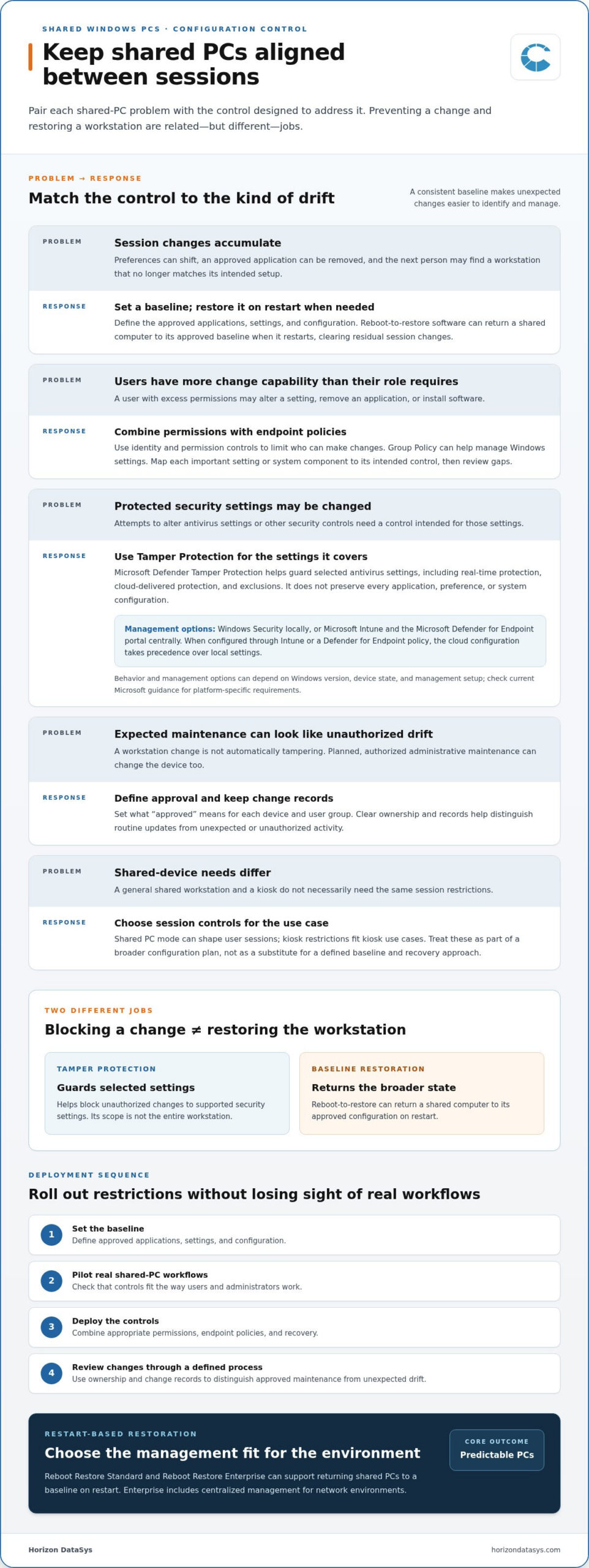
Tamper protection guards selected settings against unauthorized changes; baseline restoration returns the workstation’s broader state to an approved configuration. These controls address related but different problems. Microsoft Defender Tamper Protection, for example, helps protect specific security settings. It doesn’t preserve every application, preference, and system configuration across user sessions. The exact settings protected depend on the controls administrators deploy.
Which workstation changes should administrators treat as tampering?
Start by defining what “approved” means for each device and user group. A change made by an administrator during planned maintenance isn’t tampering simply because it alters the workstation. The same change made without authorization may be. Clear ownership and change records help separate routine updates from unexpected drift.
- Security settings: Attempts to alter protected antivirus settings or other security controls.
- Applications: Removing an approved program or making an unapproved installation when users have the ability to do so.
- Preferences and system configuration: Changing desktop, browser, network, or other workstation settings in ways that conflict with the managed setup.
Controls have different scopes. For example, Group Policy can help administrators manage Windows settings, while security features may protect particular security configurations. Neither label alone means every part of a workstation is protected. To prevent user configuration tampering, map each important setting or system component to the control intended to manage it, then review any gaps.
Why shared computers need a consistent baseline
Each session can leave a different set of changes behind. One user may adjust preferences, another may remove an application, and a later user may find a desktop or workflow that no longer matches the organization’s standard. Even harmless changes can accumulate, making shared PCs inconsistent and harder to troubleshoot.
A defined baseline gives administrators a reference for expected applications, settings, and configuration. It supports predictable administration and helps teams determine whether a change is approved, accidental, or unauthorized. A baseline doesn’t guarantee security by itself, but it helps keep workstations aligned with the configuration administrators intend to maintain. The shared computer protection software guide offers further context on approaches for maintaining shared-PC consistency.
How Tampering Happens, and What Windows Tamper Protection Covers
Configuration drift often develops through ordinary use, not a single dramatic event. Repeated sessions on a shared PC can introduce small, unmanaged changes. A user with more permissions than their role requires may alter a setting, remove an application, or install software. The next user then encounters a workstation that no longer matches its intended setup. Changes can also come from administrators, so records of approved maintenance help distinguish expected updates from unauthorized activity.
Endpoint tamper protection can block unauthorized changes to supported security settings; it doesn’t lock or restore every application, preference, and system setting on a workstation. That distinction matters when planning how to prevent user configuration tampering. Defender protection is one layer in a wider configuration strategy, not a universal configuration lock.
Where Defender tamper protection fits
Microsoft Defender Tamper Protection helps prevent unauthorized changes to selected antivirus settings, including real-time protection, cloud-delivered protection, and exclusions. Organizations can manage it locally through Windows Security or centrally through Microsoft Intune or the Microsoft Defender for Endpoint portal. When configured through Intune or a Defender for Endpoint policy, the cloud configuration takes precedence over local settings.
Its behavior and management options can depend on the Windows version, device state, and management setup. Before setting policy, consult Microsoft’s current guidance on managing Tamper Protection for platform-specific requirements and supported settings. This helps administrators align the control with their deployment instead of assuming every device behaves the same way.
Why preventing a change is different from restoring a workstation
Blocking an attempt and undoing a change are different operational tasks. Tamper Protection can guard the supported Defender settings it covers, but it isn’t designed to return every part of a shared PC to a known baseline. If a user changes an unrelated preference or removes an application, that change is outside its specific scope.
Think of the controls as complementary:
- Access controls limit who can make changes and what permissions they have.
- Endpoint policies define or enforce selected settings across managed devices.
- Monitoring helps administrators identify and investigate changes or policy issues.
- Restoration returns a workstation to an approved baseline when that is the chosen recovery workflow.
No single mechanism replaces the others, and restoration doesn’t replace endpoint security or administrative policy. Reboot Restore Standard and Reboot Restore Enterprise return shared computers to a clean baseline on restart. Enterprise also provides centralized management for network environments. This can address residual user-session changes while Defender and access policies serve their distinct purposes. Consider reboot-to-restore software for shared PCs when the operational requirement is to reset the broader workstation state, not only protect selected security settings.
The Shared-PC Tampering Prevention Checklist
A reliable checklist combines controls that govern who can change a PC with ways to define, review, and recover its approved configuration. To prevent user configuration tampering without blocking legitimate work, assign responsibility for each control and establish how authorized maintenance is requested, recorded, and validated.
Limit who can make persistent system changes
Start with identity and permissions. Review which accounts have local administrator rights, remove access that isn’t needed for a person’s role, and ensure routine shared-PC users can complete their tasks without unnecessary system-level privileges. Where appropriate, use centrally managed policies to define approved settings and restrict changes users don’t need to make.
- Review permissions: Identify administrator accounts and confirm each has a defined operational purpose. Revisit access when roles change.
- Assign change ownership: Document who can approve a baseline change, who can implement it, and who validates the result.
- Define exceptions: Provide a documented route for maintenance that requires a temporary or persistent change. Record the reason, affected devices, approval, and validation so legitimate work doesn’t become indistinguishable from unmanaged drift.
- Check adjacent access controls: Device restrictions can complement account permissions, particularly on public-facing computers. Apply relevant public computer lockdown guidance to the access patterns and tasks users actually need.
Make configuration changes visible and repeatable
Administrators need a clear reference for what each shared-PC group should look like. Maintain an approved configuration record that identifies required applications, important settings, and approved differences between device roles. Use it during reviews and after maintenance to distinguish an intentional update from an unexplained change.
- Review available evidence: Check relevant Windows, security, and device-management logs or alerts for unexpected changes and repeated attempts. Logging varies by the tools and policies deployed, so confirm which events are collected and retained.
- Test before broad rollout: Apply policy changes to a controlled group first. Verify that users can complete ordinary workflows, such as signing in, accessing required applications, and saving work as intended.
- Review and update: Periodically compare devices against the approved record. Document findings, correct unintended differences, and revise the baseline when a change is formally approved.
Keep endpoint policy and recovery decisions distinct. Policies can enforce selected settings, while reboot-to-restore can return shared computers to a clean baseline on restart. Reboot Restore Standard and Reboot Restore Enterprise support this workflow; Enterprise adds centralized management for network environments. Choose recovery controls based on how the computer is used, and retain an approved process for updates that must remain part of the baseline.
How to Deploy the Checklist Without Disrupting Shared-PC Use
Strong controls only work if people can complete the tasks the PCs are meant to support. A staged rollout lets administrators validate the baseline, identify workflow conflicts early, and refine policy before applying it across the workstation fleet. This makes it easier to prevent user configuration tampering while accounting for legitimate use and approved maintenance.
- Define the baseline. Record the applications, settings, and user tasks required for each shared-PC role. Note which changes are prohibited and which may be approved through maintenance.
- Pilot the controls. Select a representative group of devices and users. Include the workflows that matter in practice, rather than testing only whether a restriction appears to work.
- Deploy in stages. Expand the tested configuration to similar device groups, tracking which policy and baseline apply to each group.
- Review results. Examine user feedback, support requests, available logs, and documented exceptions. Adjust the configuration if restrictions interfere with approved work or fail to address recurring drift.
- Manage changes. Route baseline updates through a defined approval and validation process. Once an approved change has been tested, update the reference configuration so later restoration doesn’t remove an intended update.
Pilot policies against real user workflows
A pilot should include the applications and routine tasks users depend on, such as signing in, accessing required resources, and completing their normal work. Record which actions were blocked, which exceptions were approved, and any unexpected interruptions. If a restriction disrupts an authorized task, refine its scope or document a controlled exception before expanding deployment. This helps avoid a technically successful policy that creates practical barriers.
Education environments can use the same staged approach while accounting for classroom and lab routines. For example, validate that students and instructors can access the tools they need, then check that approved maintenance changes are reflected in the intended lab baseline. These school computer lab rollback practices provide an education-specific perspective on maintaining stable shared workstations.
Review drift and reduce repeat support work
Set a recurring review schedule that fits your operating process. Compare devices with the approved baseline, check whether exceptions remain necessary, and look for issues that recur across users or locations. Support-ticket patterns can point to a policy that blocks a legitimate task, a baseline that needs updating, or a recurring change that warrants a stronger control.
Record the issue, its cause, the corrective action, and whether the baseline changed. This helps administrators distinguish approved updates from unexplained drift and refine controls over time. For additional ideas on using recurring support patterns to improve shared-PC operations, see this shared-PC helpdesk workload guide.
For shared computers that need to return to a clean baseline on restart, Reboot Restore Standard and Reboot Restore Enterprise support the recovery stage. Enterprise adds centralized management for network environments. Explore reboot-to-restore options for shared PCs as part of a rollout designed around your users, policies, and maintenance process.
When Reboot-to-Restore Helps Keep Shared PCs on Baseline
Some controls aim to stop a change before it takes effect. Others help administrators see changes or recover from them. Shared PCs can need both: users may have to complete flexible tasks during a session, while the workstation still needs to return to an approved state for the next person. Reboot-to-restore addresses that second requirement by returning the computer to its clean baseline on restart and clearing residual session changes.
Change prevention limits what users can alter; reboot-to-restore resets the workstation to its approved baseline when it restarts. This distinction helps administrators choose controls based on the problem instead of expecting one safeguard to do every job.
Match the control to the configuration problem
Access controls limit who can make changes, and managed policies govern selected settings. Monitoring helps administrators review changes and investigate unexpected activity. Reboot restoration suits shared computers that should return to a clean baseline after use. These controls complement one another: restoring a workstation doesn’t replace endpoint security, policy enforcement, or review of suspicious activity.
| Control | Primary role | What it doesn’t do by itself |
|---|---|---|
| Access controls | Restrict who can make changes through account permissions. | Restore changes already made or preserve every workstation setting. |
| Security-setting protection | Protects supported security settings from unauthorized changes. | Lock down the full workstation state, including all apps and preferences. |
| Monitoring | Provides information to review changes and investigate activity. | Automatically prevent or reverse every change. |
| Reboot-to-restore | Returns a shared PC to its clean baseline on restart. | Replace endpoint security or determine whether a change was malicious or approved. |
In practice, an organization might use permissions to restrict system-level changes, policies to maintain required settings, and monitoring to review unexpected activity. If the operational goal is to clear user-session changes between uses, reboot-to-restore provides a direct recovery workflow. To prevent user configuration tampering effectively, match each control to its scope and keep approved maintenance within a documented change process.
Where Horizon DataSys fits in a shared-PC strategy
Reboot Restore Standard automatically returns shared computers to a clean baseline upon restart. Reboot Restore Enterprise provides the same reboot-to-restore approach with centralized management tools for network environments. That capability can help administrators manage configurations across multiple shared PCs while keeping the baseline restoration workflow clear.
Reboot-to-restore serves a different purpose from point-in-time recovery: here, it resets shared-use computers on restart rather than replacing security tools or managed configuration policies. For another layer of consistency, explore shared-PC restore solutions and consider how restart-based restoration fits alongside the access, policy, and monitoring controls already in place.
Make a Consistent Baseline Part of Your Next Review
Turn workstation consistency into an operating practice, not a one-time configuration task. Set a review point for permissions, policies, exceptions, and the approved baseline, then adjust the controls as user workflows and maintenance needs evolve. This keeps decisions deliberate and helps prevent user configuration tampering without treating every change as a threat.
Where shared PCs should return to a clean state after each restart, Reboot Restore provides that baseline restoration. Reboot Restore Enterprise also includes centralized management tools for network environments. These capabilities support a broader strategy in which security and access policies govern changes, while restoration clears residual session changes.
Choose a next step that fits your environment: refine your baseline, plan a controlled pilot, or evaluate how restart-based restoration could support your shared-PC workflow. Explore shared-PC restore solutions and build a reliable workstation experience. With clear ownership and a practical review process, your team can keep shared PCs predictable as needs change.
Frequently Asked Questions
Is Windows Defender Tamper Protection enough to prevent all user configuration changes?
No. Microsoft Defender Tamper Protection applies to supported Defender security settings, not every Windows setting, application, or user preference. A standard user might still make changes outside its scope, depending on permissions and deployed policies. To prevent user configuration tampering more broadly, combine security-setting protection with appropriate account permissions, device policies, monitoring, and a recovery plan suited to how the PC is used.
Can standard users change Windows settings on a shared computer?
Yes, standard users may be able to change some settings, though they generally don’t have the same system-level privileges as administrators. The exact options depend on Windows configuration, applied policies, and the applications users can access. For example, a user might be able to change personal display preferences but not install system-wide software. Test a standard account against actual user tasks to see which changes remain possible.
What is the difference between configuration drift and configuration tampering?
Configuration drift describes a workstation moving away from its approved state, regardless of why. Tampering refers to an unauthorized or unapproved change. Drift can result from an approved update that wasn’t reflected in the documented baseline, an accidental change, or deliberate interference. The terms can overlap, but they aren’t interchangeable: comparing a device with its approved record shows a difference, while change records and investigation help establish whether it was authorized.
How can administrators identify unauthorized changes to shared PCs?
Compare the device with its approved configuration record, then review available Windows, security, and management logs for relevant events. Look for changes that lack a matching maintenance record, such as an unexpected application removal or altered policy setting. Logging depends on the tools and event collection configured, so gaps may limit what can be established. Record findings and investigate recurring differences before treating every deviation as intentional tampering.
Does reboot-to-restore replace antivirus or endpoint security software?
No. Reboot-to-restore and endpoint security address different needs. Antivirus and other security controls help protect and monitor a device, while reboot restoration returns it to a configured state after restart. A reset shouldn’t be treated as a way to detect or contain malicious activity, and endpoint protection shouldn’t be assumed to clear every change left by users. Use restoration alongside security tools and managed policies, not in place of them.
What happens to approved updates on a shared computer that restores on restart?
Changes made during a session may be removed when the computer returns to its baseline on restart, including an update that hasn’t been incorporated into that approved state. Plan maintenance so required application or system updates are applied through the organization’s established process and retained in the intended baseline. Then verify the updated configuration before returning the PC to shared use. This helps avoid repeatedly losing approved maintenance changes.
Can a shared-PC baseline be updated when applications or policies change?
Yes. Treat the baseline as a managed reference, not a permanent snapshot that can never change. When an application or policy change is approved, test it on representative devices, confirm essential workflows still work, and document the revised configuration. Then make sure the restoration process uses the updated approved state. Keeping a record of what changed and who validated it helps administrators distinguish planned evolution from unexplained drift.