
What should happen to a shared computer when it restarts? User changes, unwanted software, and altered settings can leave a workstation in a different state from one session to the next. Shared computer protection software can help return endpoints to an approved configuration, while antivirus alone may not undo every change or reduce repeated manual cleanup.
That distinction matters to IT teams responsible for keeping computers ready for the next user without interrupting access for re-imaging or repairs. The right approach depends on whether changes should persist, how administrators want recovery to work, and how the computers are managed.
This guide compares Windows Shared PC tools, reboot-to-restore protection, and snapshot-based rollback. It explains how to assess options such as Reboot Restore Standard and Enterprise and RollBack Rx Professional against user access, IT workflows, and deployment needs, so you can choose a recovery model that keeps shared endpoints aligned with an approved baseline.
Key Takeaways
- Choose protection based on whether shared-computer changes should persist, be cleared at restart, or be recoverable through system rollback.
- Shared computer protection software complements antivirus by helping maintain system integrity and return endpoints to an approved state.
- Compare recovery triggers, user-change persistence, and administrator workflows before selecting an approach.
- List the files and approved changes that need to remain between sessions, then decide where they should be stored.
- Match automatic baseline restoration to Reboot Restore Standard or Enterprise. Consider Enterprise when centralized management is needed.
Why shared computer protection software needs more than antivirus
A shared Windows computer serves different people and tasks throughout the day. Each session can leave behind changed settings, downloaded files, or other modifications that affect the next user. Shared computer protection software helps administrators maintain endpoint integrity by providing a way to return a workstation to an approved system state.
Antivirus has a different role. It helps detect and respond to malicious software, but it doesn’t necessarily restore changed settings or return a computer to its intended configuration. A plan focused only on threat detection can leave administrators handling routine cleanup by hand.
Endpoint protection helps look for and block threats; baseline restoration returns a computer’s configuration to an approved state. These functions address different needs and can complement one another.
What makes shared Windows computers harder to maintain?
On a single-user device, ongoing changes may be expected. On a shared workstation, one person’s changes can become the next person’s starting point. A user might adjust settings, install or remove software, or interact with an application in a way that changes how the computer behaves.
Over time, these differences can produce inconsistent desktops, unexpected prompts, or applications that no longer behave as intended. IT staff then have to identify what changed and restore a familiar setup, while users face a less predictable experience. A stable baseline gives support teams a clear reference for keeping endpoints consistent.
Which risks does shared-computer protection address?
Baseline-focused tools help address persistent configuration changes, unwanted software, and disruptions to an approved setup. Restore and rollback capabilities give administrators a defined recovery path instead of requiring them to diagnose and reverse every change manually. The specific recovery behavior depends on the approach and endpoint configuration.
For context, System Restore describes a familiar Windows recovery concept: returning a system to an earlier state. Shared-endpoint resilience tools may use different recovery methods. The key buying question is what state a tool can restore and when recovery occurs, not simply whether its name includes the word “restore.”
- Threat detection helps identify or respond to malicious activity.
- Baseline restoration helps return system configuration to an approved state.
- Rollback can provide a path to an earlier system state, depending on the tool.
These capabilities don’t replace one another, and endpoint resilience isn’t a complete security program. Updates, access controls, and appropriate security tools remain part of a broader approach. Administrators also shouldn’t assume that every restart removes every threat. The practical goal is to reduce configuration drift and make recovery more consistent while maintaining the other controls the environment needs.
How shared computer protection software restores or rolls back Windows
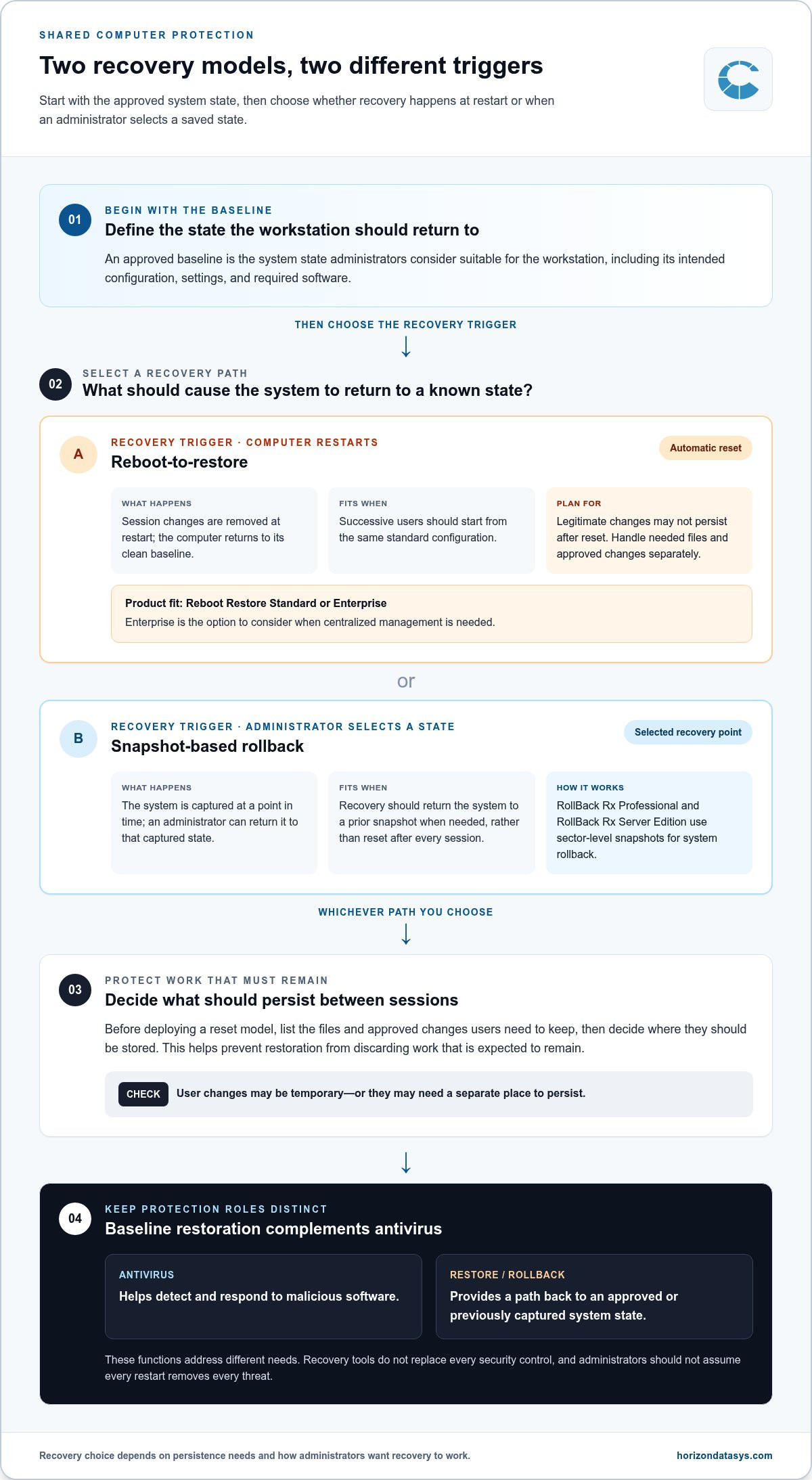
An approved baseline is a known system state that administrators consider suitable for a workstation, including its intended configuration, settings, and required software. Rather than treating every user session as a permanent change, a protection approach provides a way to return the endpoint to that defined state. This gives IT a consistent reference for recovery when the system no longer matches its intended setup.
With reboot-to-restore, changes made during a session are removed when the computer restarts, returning it to the clean baseline. This model suits shared endpoints where each user should start from a consistent configuration. It also means legitimate changes may not persist after the reset, so files or work users need later must be handled separately. The guide to how reboot-to-restore software works explains the approach in more detail.
Snapshot-based rollback follows a different recovery path. The system is captured at a point in time, and an administrator can return it to that captured state when recovery is needed. RollBack Rx Professional and RollBack Rx Server Edition use sector-level snapshots for system rollback. For more on this architecture, see sector-level snapshot software.
When does reboot-to-restore fit a shared computer?
This model fits endpoints that should return to a standard configuration after restart, such as workstations used by successive people who need the same reliable starting point. The operational trade-off is straightforward: user changes made during a session may not remain after the reset. Before deployment, decide where files and approved changes should live so restoration doesn’t discard work users are expected to keep.
When is snapshot-based rollback a better fit?
Snapshot rollback fits situations where an administrator needs to select a captured system state as a recovery point. It differs from a routine reset after every shared-user session: rollback returns the system to a prior snapshot, while reboot-to-restore is designed to clear session changes at restart. Consider whether recovery should happen routinely or only when an administrator needs to return to a captured state.
Reboot-to-restore automatically returns an endpoint to its approved baseline at restart; snapshot rollback lets an administrator return the system to a captured state. Neither recovery model replaces every security control. Antivirus serves a separate threat-detection role. The Forbes Advisor Antivirus Software Comparison covers antivirus options, which administrators can evaluate alongside configuration recovery rather than as a substitute for it.
How to compare shared computer protection software options
Compare recovery behavior before comparing product labels. The right choice depends on what should happen after a session, how administrators recover from unwanted changes, and how routine maintenance is handled. Reset-on-restart protection, snapshot rollback, and antivirus solve different problems. They may work alongside one another, but they aren’t interchangeable.
Use the criteria below to frame the decision. The “restore trigger” describes what prompts recovery, while “user changes” refers to whether ordinary session activity is intended to remain. Management needs also matter, especially when workstations are administered across a network.
| Approach | Restore trigger | Persistence of user changes | Recovery workflow | Management needs |
|---|---|---|---|---|
| Reset-on-restart | Computer restarts | Session changes are cleared as the system returns to its baseline | Automatic return to an approved configuration | Consider local setup needs and whether centralized tools are useful across networked endpoints |
| Snapshot rollback | Administrator selects a captured system state for recovery | Changes after that snapshot may not remain after rollback | Return the system to a chosen prior snapshot | Assess how administrators create and select recovery points |
| Antivirus | Threat detection or other configured security response | Doesn’t generally reset a workstation to an approved baseline | Detects and responds to threats, according to the security tool’s capabilities | Fits within the existing security administration workflow |
Which protection model matches your recovery objective?
Start with the outcome. If a workstation should return to a consistent state after every restart, baseline restoration is the closer fit. If an administrator needs to revert the system to a captured state when a problem occurs, snapshot rollback addresses that recovery objective. Keep antivirus and other established safeguards in place. System restoration is not a substitute for threat detection or a complete security program.
What operational criteria should administrators compare?
Recovery is only one part of the operating model. Before selecting shared computer protection software, map how routine changes will be handled:
- Updates: Determine how administrators apply operating system and application updates, then establish how the approved baseline will be refreshed.
- Approved changes: Identify which configuration or software changes must persist and who is responsible for incorporating them into the standard state.
- Recovery workflow: Decide whether recovery should happen automatically after restart or be initiated by an administrator for a selected snapshot.
- Administration: Match local management to standalone needs, or assess centralized tools for coordinating networked computers. Reboot Restore Enterprise includes centralized management tools for network environments.
Also assess the effect on support work and user continuity without assuming a specific reduction in effort. A routine reset can simplify a repeatable shared-computer workflow. Snapshot rollback provides a different recovery path when administrators need to select an earlier state. Choose based on the endpoint’s intended behavior, not an unsupported benchmark or headline ranking.
How to evaluate shared computer protection for your environment
Define what each endpoint is for and what a normal session should leave behind before choosing a recovery model. This sequence turns broad requirements into practical criteria for shared computer protection software:
- Define endpoint use. Identify who uses each computer, which tasks it supports, and whether sessions should start from a consistent configuration.
- Set the desired state. Record the operating system and applications the workstation needs, along with the settings that make it ready for use.
- Map changes. Separate temporary user activity from approved updates, application changes, and files that must persist. Decide where required user files belong rather than assuming they should remain on a protected system drive.
- Compare recovery models. Match the required post-session behavior to baseline restoration or snapshot rollback, then assess how administrators will handle updates and recovery.
Write down exceptions, too. If a task requires a saved file or setting to remain available, identify its approved storage location or process. This helps prevent a recovery policy from conflicting with ordinary work.
How should teams handle updates and approved changes?
Set a deliberate maintenance process before applying protection. Temporary session changes should be treated differently from approved operating system or application updates. The former may be cleared during recovery, while the latter need to become part of the intended endpoint state. Otherwise, administrators risk restoring a baseline that no longer reflects current requirements.
For each planned change, define who authorizes it, how it will be applied, and how the updated configuration will be checked. Test the resulting baseline with representative tasks and applications before returning the computers to shared use. Keep a record of the approved configuration so future maintenance has a clear reference point.
How can teams measure practical fit?
Evaluate a representative group of endpoints before expanding deployment. Include the workstations and user tasks that reflect everyday use. Observe whether computers return to the intended state, whether recovery fits the IT workflow, and whether the process interrupts access. The goal is to identify practical friction, not to claim a fixed amount of time or support savings.
Record the results against operational criteria: configuration consistency, update handling, recovery steps, user-file persistence, support effort, and administration across networked computers. Note compatibility questions that need validation against the operating environment before wider deployment. If centralized oversight is a requirement, consider the management workflow early. Reboot Restore Enterprise evaluation guidance can help frame that assessment.
Use the evaluation to decide who maintains the baseline, how exceptions are handled, and what recovery behavior users should expect. The information on Reboot Restore Enterprise provides details about centralized management for network environments.
Choose Horizon DataSys shared computer protection software by recovery need
The decision comes down to the endpoint’s intended recovery behavior. Should every restart return the computer to a clean, standard configuration, or should an administrator be able to roll the system back to a captured state? Horizon DataSys offers shared computer protection software for both objectives. Use the comparison below to identify the closest fit, then factor in how the computers are managed and how approved changes are maintained.
When should administrators consider Reboot Restore?
Choose Reboot Restore when shared computers should automatically return to a clean baseline after restart. Reboot Restore Standard provides this baseline restoration, while Reboot Restore Enterprise adds centralized management tools for network environments. This distinction helps administrators match the product to deployment needs as well as recovery behavior. Since a reset may clear session changes, plan separately for any user files or approved changes that must persist.
When should administrators consider RollBack Rx?
Consider RollBack Rx Professional when the objective is system rollback through sector-level snapshots. Rather than resetting a shared computer after each restart to clear session changes, rollback provides a way to return the system to a captured state when an administrator needs that recovery path. It is a different fit from automatic clean-baseline restoration, so select it based on how recovery should be initiated and used.
| Recovery need | Product fit | Operational distinction |
|---|---|---|
| Automatically restore a clean baseline after restart | Reboot Restore Standard | Baseline restoration on restart |
| Baseline restoration with centralized management for network environments | Reboot Restore Enterprise | Adds centralized management tools |
| Return a system to a captured state | RollBack Rx Professional | Uses sector-level snapshots for system rollback |
Before choosing, consider how the recovery model fits daily administration. For a shared endpoint that should start sessions consistently, define how IT will apply approved updates and refresh the baseline. For snapshot rollback, decide how administrators will use captured states in their recovery workflow. In either case, identify where required user files belong. Don’t assume they’ll persist through a reset or rollback unless the configuration supports it.
Also weigh local endpoint needs against network-wide oversight. A single computer may call for a straightforward baseline-restoration approach, while a network environment may benefit from centralized management. These are operational distinctions, not performance rankings. Choose according to the recovery objective, maintenance process, and level of administration your team needs.
For an overview of the available approaches, explore Horizon DataSys solutions.
Make your next step a practical one
Before changing your shared-computer setup, turn your recovery objective into a deployment plan: define the standard configuration, identify what needs to persist, and decide how administrators will maintain and review it. This preparation helps you assess whether shared computer protection software fits daily operations and gives the tools a clear role.
Horizon DataSys offers distinct recovery paths to consider. Reboot Restore returns shared computers to a clean baseline upon restart, and Reboot Restore Enterprise adds centralized management tools for network environments. RollBack Rx uses sector-level snapshots for system rollback. Treat these capabilities as part of an endpoint resilience strategy alongside the security controls your organization already relies on.
Match your endpoint requirements to the recovery approach that supports them. Explore Horizon DataSys endpoint protection solutions.
Frequently Asked Questions
Does shared computer protection software replace antivirus?
No. Antivirus and shared computer protection software address different operational needs. Antivirus helps detect and respond to malicious software, while restoration tools focus on returning a computer to an intended state. For example, if a workstation’s settings change during a session, baseline restoration can address the configuration issue; antivirus retains its separate threat-detection role. Use both as complementary controls within a broader security plan.
Can users save files on a computer that restores its baseline after restart?
They can, but whether a file remains available after restart depends on where it’s saved and how the endpoint is configured. Before deployment, test a representative user workflow: create a sample document, restart the computer, and check whether the file is still accessible. Decide which files must persist and provide an approved storage location or process for them. Don’t assume files saved during a session will survive restoration.
Is reboot-to-restore software the same as a backup?
No. Reboot-to-restore is intended to return a protected computer to an approved baseline after restart; it isn’t a substitute for maintaining copies of important files. If a user needs to keep a project, records, or other work, plan separately for how those files will be retained and recovered. Treat system consistency and file preservation as distinct requirements, and make sure your procedures address both.
Can shared computer protection software prevent every malware infection?
No. Baseline restoration should not be treated as a guarantee that malware can’t affect a computer. Restoration may help return a system to its intended configuration, but it doesn’t remove the need for antivirus, updates, access controls, and other appropriate safeguards. Administrators should also avoid assuming that a restart clears every threat. Define recovery procedures alongside prevention and detection controls to address different stages of an incident.
What is the difference between reboot-to-restore and snapshot rollback?
Reboot-to-restore is designed to return a shared computer to its clean baseline as part of the restart workflow. Snapshot rollback returns a system to a captured state when an administrator needs that recovery option. The difference is the intended trigger and workflow: routine restoration after restart versus recovery to a selected system state. Match the method to whether session changes should routinely be cleared or a prior state may need to be restored.
Can administrators manage protection across multiple shared computers?
Yes. Reboot Restore Enterprise includes centralized management tools for network environments, which can help administrators manage protection across connected endpoints. Before rolling out a shared policy, identify which computers need the same baseline and where local requirements differ. Also define who is responsible for approved changes and maintenance. Clear ownership helps keep endpoint configurations aligned without assuming every workstation should use identical settings.
How should an organization test shared computer protection before deployment?
Start with a representative group of computers and the tasks users perform during an ordinary session. Check whether each endpoint returns to the intended state, whether required files remain accessible through the planned workflow, and whether approved updates can be applied and validated. Record compatibility questions for the specific Windows environment and deployment requirements. Use the results to refine procedures before extending protection to additional workstations.