
What if restoring a Windows endpoint didn’t mean rebuilding the drive from scratch? When a failed update, unwanted configuration change, or system disruption interrupts work, instant disaster recovery software can offer a faster way back to a usable state. IT teams should also ask whether that speed comes at the expense of dependable backups. It doesn’t have to: rollback and backup address different recovery needs.
Snapshot-based rollback can return a Windows system to an earlier state in seconds, without full drive re-imaging. RollBack Rx Professional and RollBack Rx Server Edition work below Windows using sector-level snapshots. This makes rollback a system-recovery layer within a broader resilience plan, not a replacement for backups. Backups remain important for recovering data and responding to broader incidents, while rollback can reduce hands-on restoration work for certain endpoint and server disruptions.
This guide explains how rollback differs from image recovery and cloud disaster recovery, which incidents each approach can address, and how to assess recovery speed, scope, and operational fit. You’ll also see how snapshot rollback compares to baseline-on-restart alternatives, so you can choose a practical next step from Horizon DataSys for your Windows environment.
Key Takeaways
- Identify the recovery layer that fits the disruption, from restoring a system to a prior state to recovering files or cloud infrastructure.
- Understand the general recovery sequence and why the exact steps depend on the technology and Windows configuration.
- Compare instant disaster recovery software with backups and re-imaging by recovery scope, workflow, and role in your resilience plan.
- Set recovery time and recovery point expectations for each workload before assessing solutions.
- See how RollBack Rx snapshot-based rollback differs from Reboot Restore’s baseline-on-restart approach for shared computers.
What Instant Disaster Recovery Software Means for Windows Systems
Instant disaster recovery software is designed to return a computer or server to a usable prior state quickly after a disruption. The term describes a recovery goal, not one universal method. A tool may restore Windows system state, recover files or applications, or bring cloud infrastructure back online. These capabilities have different scopes, so a fast system rollback shouldn’t be mistaken for recovery of every part of an organization’s environment.
For Windows endpoints and local servers, rollback targets the operating system’s condition at a selected recovery point. RollBack Rx Professional and RollBack Rx Server Edition use sector-level snapshots and operate below Windows to support rollback without full drive re-imaging. The software is designed to restore systems in seconds, but this is system recovery, not a solution for every data, application, or infrastructure failure.
Rollback, backup storage, replication, and disaster recovery planning solve related but separate problems. A backup preserves data for recovery; replication maintains another copy of data or systems; rollback returns a protected system to an earlier state. A broader IT disaster recovery plan coordinates recovery with business continuity, including which services must return first and what dependencies they need.
Which recovery problems can endpoint rollback address?
Rollback can help after a system crash, an unwanted configuration change, or a software-related disruption leaves a Windows machine unstable or unusable. Instead of rebuilding the drive from an image, an administrator can return system state to a prior point. The goal is to reduce restoration work for that system, not to recover every business asset or guarantee protection from every attack, hardware failure, or outage.
Why recovery scope matters to IT teams
When a workstation or server is unavailable, staff may lose access to the applications and services they rely on. Restoring an endpoint’s system state is different from recovering a business application, its data, or an entire site. Matching the recovery method to the affected layer helps teams plan for continuity without assuming one tool covers every need.
Two planning terms help define that fit:
- Recovery time objective (RTO): how long a workload can remain unavailable before its impact becomes unacceptable.
- Recovery point objective (RPO): how much recent data the organization can afford to lose, expressed as the point in time to which it needs recovery.
A server might need a short RTO because several teams depend on it, while a separate data store may have a stricter RPO because recent transactions matter. Rollback can address the system-state layer; backups and other recovery measures are still needed for data and broader disruptions. Define these requirements by workload to clarify which recovery layers to combine.
How Instant Disaster Recovery Software Restores a Windows System
Recovery generally follows a clear sequence, although controls and available recovery points vary by technology and system configuration. Before selecting a method, identify what state it captures and which systems depend on it. Snapshot-based rollback focuses on the Windows system’s recorded drive state, rather than simply copying selected files.
- Capture a recovery point. The software records a state that can be used for recovery. With sector-level snapshots, that state reflects drive-level system information rather than an ordinary file-by-file copy.
- Identify the incident. Determine whether the problem is a system crash, a problematic software change, or another disruption affecting the machine. The cause helps IT assess whether returning to an earlier system state is appropriate.
- Select a usable state. Choose a recovery point from before the disruption, based on the system’s condition and the organization’s recovery requirements.
- Restore the system. The recovery technology applies the selected state. The precise steps and outcome depend on the software, system configuration, and nature of the incident.
What sector-level snapshots contribute
A snapshot is a recorded recovery state that can support returning a system to an earlier condition. RollBack Rx Professional and RollBack Rx Server Edition use sector-level snapshots, capturing system state at the drive level rather than relying on a simple collection of file copies. This explains the technology’s role in recovery. For more detail, see this sector-level snapshot software guide.
Snapshots are recovery points, not a complete resilience plan. On their own, they don’t establish that every business application, data source, or dependent service can be recovered. The U.S. government’s Developing an IT Disaster Recovery Plan guidance emphasizes planning for technology assets, helping teams place system rollback within a broader recovery process.
Why below-OS recovery changes the workflow
RollBack Rx is designed to operate below the Windows operating system. Unlike recovery performed through Windows, below-OS rollback restores a selected system state without relying on Windows as the recovery layer. This makes the approach relevant when Windows itself is part of the disruption, although the specific recovery path depends on the configuration and incident.
Rebuilding Windows and restoring a full drive image can involve replacing the system state from a prepared image. RollBack Rx supports rapid rollback from sector-level snapshots without full drive re-imaging. Its stated capability is restoration in seconds, not a guarantee that every incident or configuration will recover in that time. For local-server teams assessing this approach, Windows system rollback solutions provide a starting point for considering how snapshot recovery could fit into their environment.
Instant Recovery vs. Backups, Re-Imaging, and Cloud Disaster Recovery
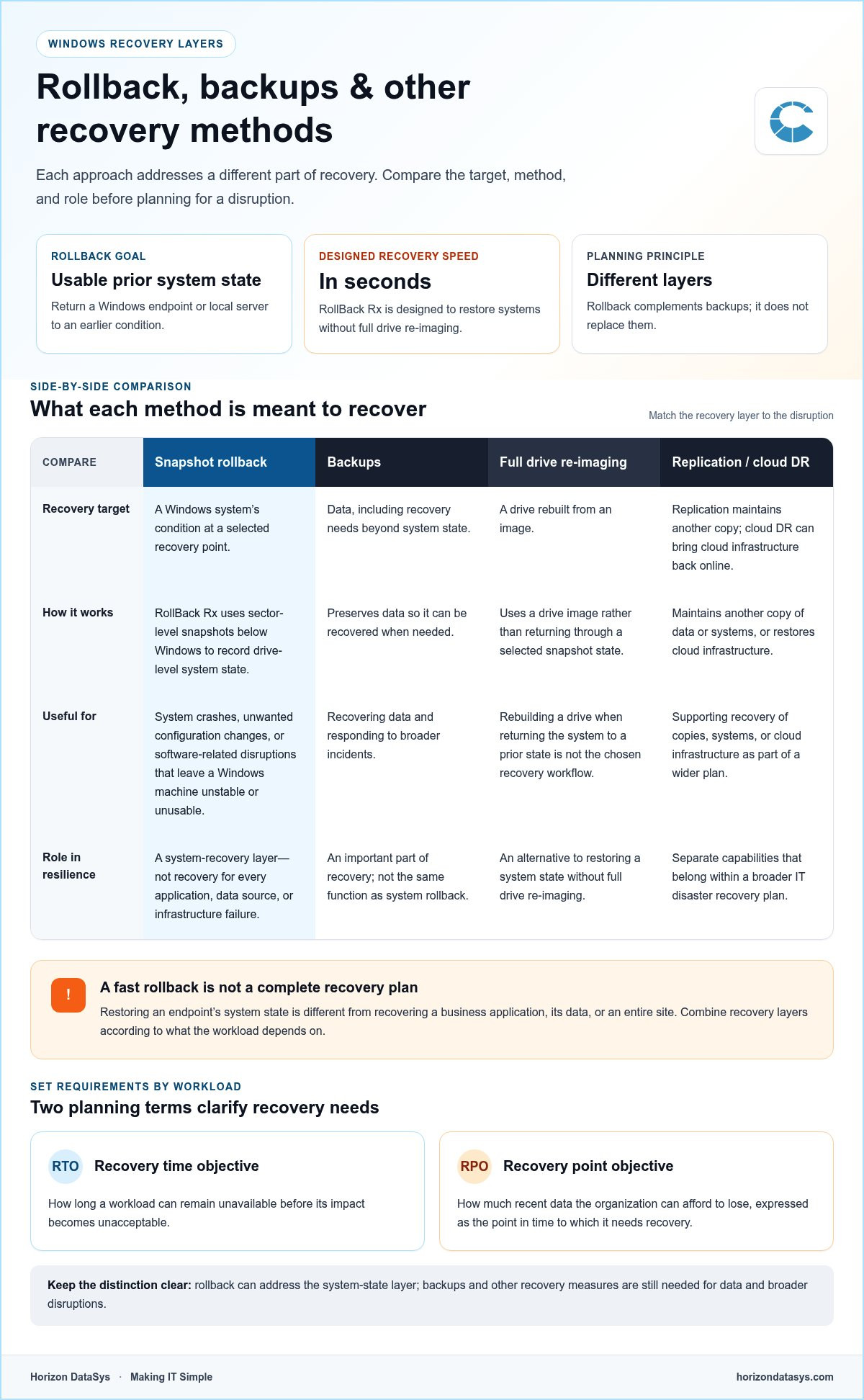
These recovery methods solve different problems. Instant rollback can return a Windows system to a selected prior state, while backups preserve copies of data, re-imaging rebuilds a machine from a prepared image, and cloud disaster recovery helps restore infrastructure and dependent services. Comparing their scope and workflow makes it easier to assign each layer a clear role instead of expecting one method to cover every incident.
| Approach | Recovery scope | Typical workflow | Role in a resilience plan |
|---|---|---|---|
| System rollback | A Windows system’s prior state | Select a recovery state and roll the system back | Reduce disruption from system-level changes or instability |
| Backup | Recoverable copies of data | Retrieve the needed data from a retained copy | Protect data for restoration after loss or damage |
| Image-based re-imaging | A system rebuilt from a prepared drive image | Apply the image to rebuild the machine | Provide a rebuild path when a system needs to be replaced or reconstructed |
| Cloud disaster recovery | Infrastructure, workloads, and service dependencies | Recover or activate resources in a cloud environment | Support continuity beyond a single Windows endpoint |
When rollback and traditional backup serve different needs
Rollback focuses on system state; backup focuses on retaining recoverable data copies. If a configuration change disrupts a server, rollback may address the affected system. If files are lost or data must be retrieved from an earlier copy, backup has a distinct role. A sound plan can use both: rollback for system restoration and independent backups for data recovery.
These layers shouldn’t be conflated. Backup retention, storage location, and recovery processes are separate from RollBack Rx’s capabilities. Snapshot-based rollback also differs from returning a shared computer to a fixed baseline on restart. That baseline-reset approach is the focus of reboot-to-restore software.
When re-imaging or cloud recovery remains relevant
Re-imaging rebuilds a system from a prepared image, so it may suit cases where a full reconstruction is needed. Its workflow and timing depend on the environment; it isn’t interchangeable with rolling back a system state. Cloud disaster recovery addresses a broader scope, such as infrastructure and connected services that a single endpoint rollback cannot restore.
For example, if a local Windows server becomes unstable after a software change, rollback may address that system-level disruption. If the incident affects the server’s data, backups remain important. If a wider outage disrupts infrastructure and dependent services, a broader recovery plan is needed. Instant disaster recovery software complements independent backups by reducing system-restoration work, not by replacing data protection or organization-wide disaster recovery planning.
How to Evaluate Instant Disaster Recovery Software for Your Environment
Start with the systems your organization needs to protect, then map their dependencies and the disruptions they must withstand. A shared workstation used for routine tasks has different recovery needs from an individual endpoint or a local Windows server supporting essential services. This inventory keeps evaluation grounded in operational requirements rather than feature lists alone.
Before comparing instant disaster recovery software, define recovery expectations for each workload. The recovery time objective (RTO) is how long a system or service can be unavailable; the recovery point objective (RPO) is how much recent data the organization can afford to lose. These targets help show where rollback may reduce restoration work and where backups or broader continuity measures remain necessary.
- List protected systems: Record endpoints, shared computers, servers, applications, and the services that depend on them.
- Describe likely disruptions: Include system instability, unwanted changes, data loss, and outages that affect multiple services.
- Set workload-specific targets: Define acceptable downtime and data-loss limits instead of applying one expectation across the environment.
- Map existing safeguards: Note how rollback fits alongside backups, security procedures, and continuity plans.
Match recovery capabilities to workloads
Choose a recovery approach based on how each system is used. A shared workstation may benefit from returning to a known baseline on restart, while a Windows endpoint or server may need point-in-time system rollback. These are distinct workflows, not interchangeable labels. A Windows system rollback buying guide can help frame the capabilities to compare with your requirements.
For each workload, identify what must be restored and what falls outside the recovery scope. A server may depend on applications and data beyond its Windows system state, so include those dependencies in the plan rather than assuming system rollback covers them.
Validate recovery plans before an incident
Test a documented plan using controlled scenarios that reflect actual operational needs. Assign responsibility for selecting a recovery point, carrying out the procedure, and confirming that the system or service is usable afterward. Tests reveal whether the chosen method fits the scenario without relying on assumed performance benchmarks.
After each exercise, record what was restored, what remained outside scope, whether the intended recovery objective was met, and what follow-up actions are needed. Keep responsibilities and procedures current as systems and dependencies change. This gives the people carrying out recovery a clearer process to follow.
Once your requirements are documented, explore Horizon DataSys recovery solutions to see how Windows rollback and reboot-to-restore approaches can fit into your environment.
Applying Instant Recovery to Windows Workstations and Servers
Choose an approach based on the system’s role. A workstation may need a quick return to a stable state after an unwanted software or configuration change. A local Windows server may need the same kind of rollback while remaining part of a wider recovery plan for applications and data. Horizon DataSys’ RollBack Rx family is designed for Windows system snapshots and rollback, providing an instant disaster recovery software layer focused on system state.
Where RollBack Rx fits in a recovery plan
RollBack Rx Professional and RollBack Rx Server Edition use sector-level snapshots and operate below the Windows operating system. Their stated capability supports rolling a system back in seconds without full drive re-imaging. RollBack Rx serves as a Windows system-recovery layer, not a cloud backup service or a substitute for protecting data and planning recovery for connected services.
For local-server administrators, the distinction is practical: rollback addresses the Windows system’s condition, while broader plans account for the server’s applications, data, and dependencies. These layers can work alongside one another, with the appropriate method selected for the disruption and recovery objective. Server-focused teams can use this instant system restore for Windows Server guide to explore the server use case in more detail.
Choose the recovery approach that matches the system
Point-in-time rollback and restart-based baseline restoration serve different operational needs. RollBack Rx Professional is designed for Windows workstation system rollback, while RollBack Rx Server Edition is the server-focused option. Both use sector-level snapshots to support rapid rollback. This recovery-point approach suits returning a system to an earlier state after a disruption, rather than resetting it to the same baseline on every restart.
For shared computers that should consistently return to a clean baseline after restarting, Reboot Restore follows a different model. Reboot Restore products return shared computers to a baseline on restart, and Reboot Restore Enterprise offers centralized management for reboot-to-restore configurations. This can suit environments where users make temporary changes but the computer should return to a known starting state for the next session.
Before choosing, map each system to its purpose. Identify whether staff need a particular prior system state restored after an incident, or whether shared devices should reset to a baseline on restart. Include backup and service recovery needs in the same plan. This distinction clarifies where rollback can reduce hands-on restoration work and where other recovery layers remain necessary.
Review the product details against your Windows environment and recovery requirements. Explore Horizon DataSys system recovery software to compare the available approaches for workstations and servers.
Make Your Recovery Plan Operational
Turn recovery requirements into a clear decision for each Windows system: what needs to return to service, which recovery layer is responsible, and who will carry out the procedure. This keeps system rollback connected to the wider resilience plan rather than treating it as a standalone safeguard.
For teams considering instant disaster recovery software, Horizon DataSys offers RollBack Rx Professional for workstations and RollBack Rx Server Edition for servers. Both use sector-level snapshots and operate below Windows, supporting a distinct system-recovery role alongside independent backup and continuity measures. Assess the product details against your environment, then document how the selected approach fits your recovery responsibilities.
A measured review can make the next recovery decision clearer for the people responsible for keeping systems available. Explore Horizon DataSys system recovery software to take a practical next step toward a more prepared Windows environment.
Frequently Asked Questions
Is instant disaster recovery software a replacement for backups?
No. Rollback and backups address different recovery needs: rollback can return a Windows system to an earlier state, while independent backups preserve data copies for recovery. For example, restoring a server’s system state won’t necessarily retrieve a deleted project file. Map each method to the assets and recovery objectives it supports, then include both in a tested resilience plan where appropriate. Neither approach covers every incident on its own.
How does instant disaster recovery software differ from a system image?
A system image is a prepared copy used to rebuild or restore a drive; rollback software uses recorded recovery states to return a system to an earlier condition. The workflow and scope depend on the product and setup. RollBack Rx provides a practical example: its sector-level snapshots support rollback without full drive re-imaging. The distinction is whether the task calls for rebuilding from an image or returning the system to a prior state.
Can instant recovery software help after a ransomware incident?
System rollback may help return a Windows system to an earlier state, but it shouldn’t be treated as a promise of ransomware removal or complete remediation. An affected server, for example, may have dependencies or data requiring separate investigation and recovery. Follow established incident-response procedures, assess affected systems and information, and use independent backups where needed. Rollback can be one recovery layer, but it doesn’t replace security controls or incident handling. For organizations seeking comprehensive defense and incident readiness, managed IT providers like trinitynetworx.com offer proactive cybersecurity and business continuity support.
How quickly can RollBack Rx restore a Windows system?
Horizon DataSys describes RollBack Rx rollback as taking seconds. This is a product capability statement, not a guarantee for every system, incident, or recovery objective. Actual recovery needs depend on the workload and situation. IT teams should identify the systems that matter most, define acceptable downtime, and validate procedures through controlled testing rather than relying on a universal time commitment or assumed benchmark.
Does instant disaster recovery software work when Windows will not start?
Recovery behavior depends on the product’s architecture and the system’s condition. RollBack Rx operates below the Windows operating system, distinguishing its recovery layer from workflows that rely on Windows itself. That fact alone doesn’t establish how every no-start situation will be handled. Document the recovery procedure for the specific configuration, and include a controlled test that reflects the system condition your team needs to prepare for.
What should an IT team test before relying on instant recovery software?
Test a representative scenario, such as a server made unusable by an unintended configuration change, in a controlled setting. Decide which recovery objective applies, who initiates the procedure, and who verifies the result. Record the system state restored, dependencies or data that remain outside scope, and follow-up actions. Then align the findings with backup and incident-response plans. A successful exercise informs planning, but doesn’t prove protection against every outage or attack.
Is instant disaster recovery software only for servers?
No. Workstations and servers can have distinct recovery needs. Horizon DataSys offers RollBack Rx Professional for workstation system rollback and RollBack Rx Server Edition for server rollback. For shared computers, Reboot Restore Standard and Reboot Restore Enterprise return systems to a baseline on restart, with Enterprise offering centralized management for reboot-to-restore configurations. These products address different use cases, so match the approach to how each Windows system is used.