
What if every class could begin at a dependable workstation, without IT rebuilding yesterday’s changes by hand? In a shared lab, students can alter settings, install unwanted software, or leave files behind. Those inconsistencies can turn routine preparation into recurring cleanup. The right school computer lab rollback software makes restoration part of a repeatable operating process instead of another manual task.
A stable baseline matters, but so does how the school manages it. Updates need a controlled path from testing to rollout, while legitimate classroom changes and student work need clear handling before a computer resets. Rollback should also complement, not replace, appropriate file backups.
This guide explains how to evaluate and operate rollback software around those practical needs. You’ll learn how reboot-to-restore differs from snapshot-based rollback, what to plan for when managing updates and local files, and when centralized management can help across networked workstations. Reboot Restore automatically restores a baseline on restart, while RollBack Rx Professional provides sector-level snapshots for rapid system rollback. Understanding the difference helps you match the approach to your lab’s workflow.
Key Takeaways
- Evaluate school computer lab rollback software by how it restores workstations, how administrators control it, and what routine maintenance it requires.
- Define which student files and approved classroom changes must persist before setting a restoration policy.
- Use a documented lifecycle to pilot changes, schedule maintenance, validate the baseline, and monitor lab readiness.
- Separate student sessions from administrator maintenance so updates can be applied and tested without disrupting normal lab use.
- Match the solution to your workflow: Reboot Restore Standard or Enterprise supports baseline restoration on restart, while Enterprise adds centralized management for networked environments.
Why school computer lab rollback software matters for shared PCs
A lab computer has to serve different students, classes, and tasks while remaining ready for the next session. Rollback software helps by returning a workstation to an intended system state, according to a defined restoration approach. Instead of relying on staff to inspect and manually clean every PC between uses, administrators can establish a known baseline and make recovery a planned part of lab operations.
That baseline supports continuity, but it does not promise that every problem will be prevented. Rollback can help restore system configuration after changes, but schools still need appropriate security controls, maintenance routines, and a separate strategy for protecting important files. For a broader view of options and selection considerations, consult this shared computer protection buying guide.
How classroom use creates baseline drift
Each login brings a different pattern of use. One class may work in a browser, another may use specialized applications, and a student may change settings or save material locally. Over time, these ordinary changes can leave workstations with different preferences, shortcuts, temporary files, or system configurations. Even small differences can mean a lesson starts with a missing setting or an application that behaves differently from one PC to the next.
Not every change is unwanted. An administrator might approve a new application, adjust a configuration for a course, or apply an operating system update. The operational distinction is whether a change belongs in the intended baseline. Without a clear process for approving and preserving changes, restoration may remove a needed update. Leaving every change in place, however, can allow endpoints to drift apart. That inconsistency makes lesson preparation less predictable and complicates troubleshooting: IT must first determine whether a fault is isolated or reflects different workstation states.
What rollback can and cannot solve
Rollback restores system state according to the method and baseline configured for the workstation. For example, reboot-to-restore is designed to return a shared PC to its controlled state after restart. Other approaches use snapshots that let an administrator select a prior system state. The general idea of returning system files and settings to an earlier condition is also described in the Windows System Restore overview, though dedicated rollback products and Windows features shouldn’t be assumed to work identically.
Define file handling before enabling automatic restoration. If students save work locally, that work may not belong in a system baseline that resets. Direct students to approved storage locations and make clear which classroom changes are temporary and which require administrator approval. Rollback restores the configured system state; it isn’t a backup of student documents and shouldn’t be treated as one.
Rollback also does not eliminate malware, outages, or user mistakes. It can support a predictable recovery process after changes, but works best as one part of a broader operating plan. Clear restoration rules help schools keep lab PCs consistent without confusing a clean baseline with complete protection.
How school computer lab rollback approaches restore Windows PCs
Rollback methods differ in what triggers recovery and how much choice an administrator has over the destination state. That distinction shapes a lab’s daily rhythm: computers may return automatically to one approved baseline, or IT may select a recorded state when a specific issue needs attention. Understanding the workflow helps staff set expectations before class and plan updates without surprising students or teachers.
For shared PCs that should be ready in a consistent condition after each session, reboot-to-restore offers a straightforward cycle. A workstation starts from its configured baseline, students use it during class, and a restart returns it to that baseline. This reboot-to-restore software guide explains the approach in more detail.
Reboot-to-restore for recurring classroom sessions
The sequence is simple: students use the computer, the session ends, and the next restart restores the configured state. That automatic reset can reduce the need to check each workstation for session-to-session changes, making it useful when the same machines move through different classes and activities.
Intentional changes need a separate routine. Schedule administrator maintenance so staff can apply and test approved updates, then establish the intended baseline before ordinary classroom use resumes. Tell teachers and students that changes made during routine sessions may not remain after a restart. Clear expectations help prevent lost work and confusion about why settings or applications look different later.
Snapshot rollback for targeted system recovery
A snapshot records a system state that can be used as a rollback point. Instead of always returning to one baseline at restart, an administrator can choose a prior recorded state when that better fits the recovery need. RollBack Rx Professional uses sector-level snapshots for rapid system rollback, which can be useful when IT needs more targeted control over which prior state to restore.
The choice depends on the operating model. If the main goal is predictable readiness after each class, automatic baseline restoration may fit better. If administrators need to select a recorded state to address a particular system change, snapshots offer a different kind of flexibility. In either case, agree on how updates will be tested and what state should be considered approved before recovery is needed. The Windows system rollback buying guide offers additional comparison context.
Choose the recovery behavior that matches your lab’s schedule, then document the maintenance routine around it. To explore endpoint resilience options for shared PCs, review Horizon DataSys software.
How to compare school computer lab rollback software
Compare recovery behavior with the way a lab is actually used, not just the number of features on a product page. A school with back-to-back classes may value automatic restoration at restart, while IT teams handling varied system changes may need to select a prior recovery state. The right fit depends on how computers are shared, who administers them, and when workstations can be taken out of service for maintenance.
| Comparison point | Reboot-to-restore | Snapshot rollback |
|---|---|---|
| Recovery trigger | Returns the computer to its configured baseline after restart. | Administrator selects a recorded system state for rollback. |
| Administrator control | Centers on maintaining one intended baseline for routine use. | Offers a choice of recovery point for a particular system issue. |
| Maintenance implications | Requires an intentional process to apply and retain approved baseline changes. | Requires a process for managing and choosing relevant snapshots. |
Match the recovery model to the lab schedule
For computers used by multiple classes throughout the day, assess whether restoration after restart fits the school’s session routine. It can make a consistent starting state part of the normal handoff between users. If IT more often needs to troubleshoot a specific change and return a workstation to a selected earlier state, snapshot-based rollback may be more suitable. Neither model is universally best; compare the recovery trigger with the lab’s real schedule and support needs.
Consider the effect of each model on teaching time. If restoration requires a restart, decide when that restart can occur and communicate what students should save before a session ends. If recovery is administrator-selected, establish who makes that choice and how the affected PC will be returned to instruction. Clear expectations help prevent recovery routines from disrupting class.
Assess administration and operational fit
IT staff overseeing networked workstations should consider whether they need centralized visibility and control. Reboot Restore Enterprise supports centralized management across network environments, while Reboot Restore Standard and Enterprise restore shared computers to a clean baseline on restart. RollBack Rx Professional uses sector-level snapshots for rapid system rollback. These distinctions help connect management needs to recovery behavior.
Before choosing, map approved updates and software changes to existing maintenance routines. Identify who tests changes, when they can be applied, and how staff will confirm that the intended configuration remains ready for classes. Also verify compatibility with the school’s Windows versions and hardware, along with deployment, licensing, and configuration details for the environment. Treat these as implementation checks rather than assumptions based on a general product description.
A useful decision reduces uncertainty for IT and educators: know what triggers recovery, who controls it, and how maintenance affects availability. Compare those requirements before settling on school computer lab rollback software, then assess the options against the lab’s day-to-day workflow.
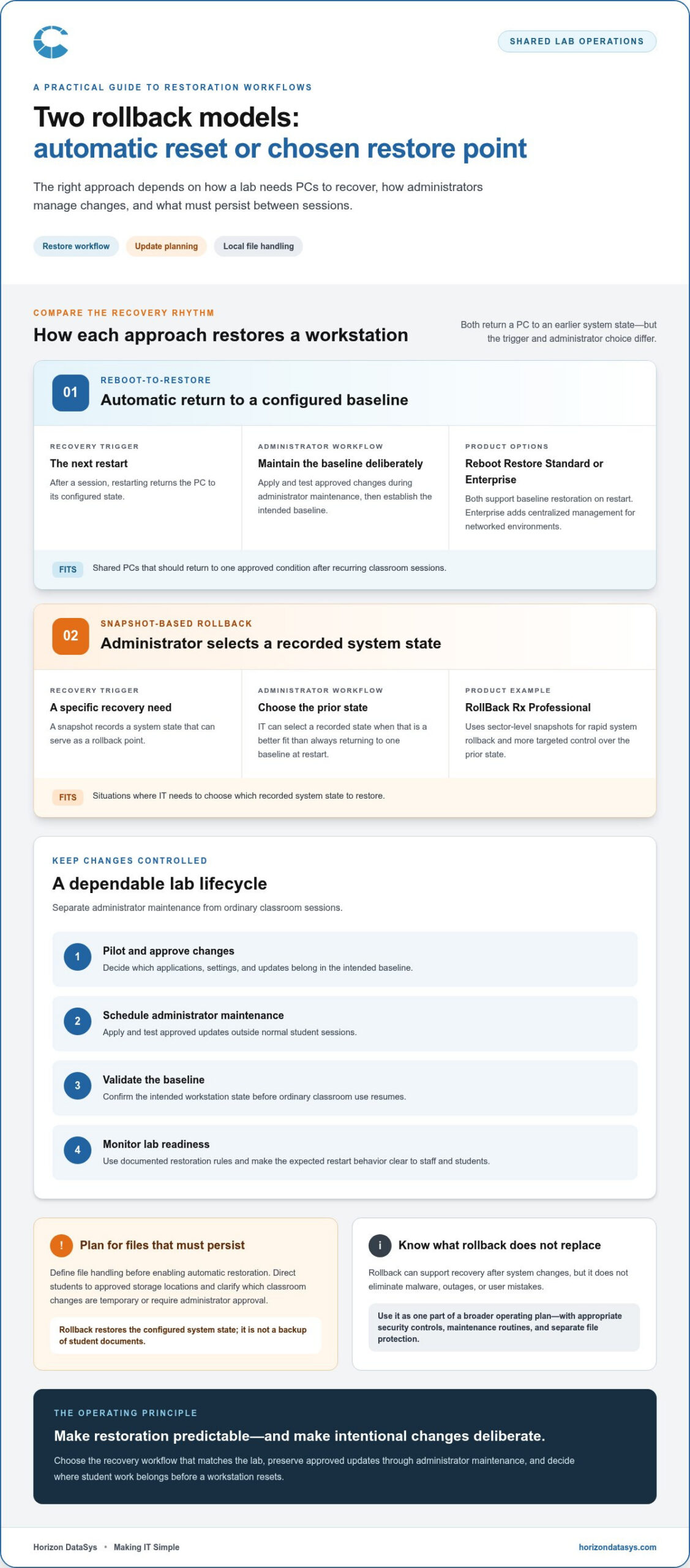
School lab rollback best practices for updates and daily operation
A reliable rollback setup depends on the operating routine around it. Separate student use from administrator maintenance so a routine restart doesn’t interrupt an update in progress or erase a change before it’s approved. Use this lifecycle to keep baseline changes deliberate and give staff a clear way to confirm that lab PCs are ready for class.
- Document the baseline. Record the approved operating system and application configuration, along with the classroom tools that must work. Note which changes are temporary and which require IT approval.
- Pilot changes. Apply proposed operating system or application updates to a small test group first. Check for issues with the software and activities teachers rely on before expanding the change to more workstations.
- Schedule maintenance. Coordinate updates with the school’s maintenance calendar and reserve a controlled window for administrator work. Keep routine student sessions separate from this window.
- Validate the result. After applying changes, restart and test the lab’s key classroom applications. Confirm that the intended configuration remains in place and that the recovery behavior matches the documented plan before returning PCs to service.
- Monitor and refine. Give staff a consistent way to report workstation issues, including the device, class or activity affected, and what happened. IT can use these reports to identify recurring problems and confirm restored readiness after recovery.
Plan updates without disrupting classes
Use the maintenance calendar to avoid making changes during active instruction or just before a lab is needed. During the planned window, apply approved updates to the pilot group and test representative classroom applications, such as the tools needed for a scheduled lesson. If an update changes the approved configuration, document the result and ensure it becomes part of the intended baseline. This helps prevent an automatic reset from undoing a legitimate change.
Before broad deployment, confirm the pilot computers can complete the expected classroom workflow. If a change causes an application problem, pause the rollout and record what needs investigation. A controlled process makes updates planned work instead of a surprise across the lab, helping protect class time.
Set expectations for user files and recovery
Tell students and staff where to save work under school policy, and make clear that locally stored files or session changes may not persist after a restart. A short reminder at the end of class can prevent confusion and avoidable requests to recover work. Document who should receive reports about missing files or a workstation that fails to return to its expected state.
Define what IT checks before marking a computer ready again: successful restart, expected system state, and access to the applications required for class. Apply the same confirmation steps after routine maintenance and recovery. For teams aligning endpoint resilience tools with this operating process, explore endpoint resilience software.
Choose a school computer lab rollback solution and plan next steps
The best fit is the recovery model your lab can operate consistently. Match how and when computers should reset with the level of administrator control you need, then check that the maintenance routine can accommodate updates, testing, and classroom schedules. A sound choice should make workstation readiness more predictable without creating a process staff can’t sustain.
When Reboot Restore fits a shared computer lab
Reboot Restore Standard and Reboot Restore Enterprise return shared computers to a clean baseline upon restart. That behavior can suit Windows workstations used by recurring classes, where a familiar starting state is needed for each session. Enterprise adds centralized management for network environments, which is relevant when IT oversees lab computers across a network.
Decide whether automatic baseline restoration matches the way your school closes sessions and prepares machines for the next class. Also account for intentional maintenance: administrators need a defined process to apply and retain approved changes. Evaluate the product in your actual environment, including applicable Windows and hardware compatibility as well as deployment and configuration requirements, rather than assuming these details from the recovery model alone.
Prepare a measured evaluation
Before adopting school computer lab rollback software, gather the operational details that will shape its use. Start with a focused planning checklist:
- Inventory the lab. Record the device count, how workstations are grouped, and whether IT needs centralized administration.
- Describe user patterns. Note how classes share computers, when sessions end, and which approved applications and settings must be present.
- Set maintenance windows. Identify when IT can apply changes and test workstations without disrupting scheduled instruction.
- Define the baseline. Document the intended system state and clarify which changes should persist after maintenance.
- Choose a pilot group. Include representative workstations and classroom applications before expanding the process to the wider lab.
Set success measures before the pilot begins. Determine how staff will confirm that a PC returns to the expected state, whether key classroom applications are ready, and how teachers report issues. Record failures and interruptions as well as successful resets. This gives IT evidence to refine the operating process before applying it to more workstations.
Finally, confirm how student and staff files are handled under school policy, and make sure users understand what may not remain after a restart. Rollback supports system recovery, but it does not replace a separate strategy for protecting important files. With restoration behavior, management needs, maintenance windows, and evaluation criteria aligned, administrators can select a solution based on lab operations rather than assumptions.
To assess whether restart-based baseline restoration fits your shared-PC workflow, explore Reboot Restore solutions.
Put your lab’s next maintenance cycle to work
Turn the lab’s operating needs into a practical evaluation. Use an upcoming maintenance cycle to confirm who approves changes, how staff will test them, and what evidence shows that a workstation is ready for class. This gives IT a clear way to assess whether school computer lab rollback software fits the school’s daily workflow before extending the process across more PCs.
As you evaluate options, connect the recovery model to the task at hand: Reboot Restore returns shared computers to a clean baseline on restart, Reboot Restore Enterprise adds centralized management for network environments, and RollBack Rx Professional uses sector-level snapshots for rapid system rollback. The right starting point depends on the consistency and control your lab needs.
Build a measured pilot around your own devices, classroom applications, and maintenance routines. Then use what you learn to decide on the next stage. Explore Reboot Restore solutions and take the next step toward a more predictable lab.
Frequently Asked Questions
Can school computer lab rollback software preserve student files saved during a session?
It depends on where the files are saved and how restoration is configured, so don’t assume work stored locally will remain after recovery. Direct students to school-approved storage for assignments they need later, and test the expected file workflow on a pilot computer. For example, save a document to the approved location, restart the workstation, then confirm the student can access it. Keep file retention rules separate from system restoration settings.
Does rollback software replace backups for school computers?
No. Rollback restores a system state; it isn’t a substitute for backing up important files. Schools should maintain a separate process for protecting student work, staff documents, and other data that must survive a system recovery or hardware failure. Define who is responsible for verifying that important files are stored in the approved location, and periodically test that the school’s recovery process can retrieve them when needed.
Can rollback software work with a school’s existing domain policies?
It may fit into a domain-managed environment, but administrators should validate the interaction rather than assume policies and restoration will behave as intended together. In a pilot, check how policy-applied settings appear after restart, whether required configurations return, and whether changes reach the workstation on the expected schedule. Include the school’s actual login and network conditions in testing. Confirm compatibility and configuration requirements for the specific environment before deployment.
How should IT teams apply Windows updates to rollback-protected lab PCs?
Use a controlled maintenance process. Apply updates to a test workstation during an approved window, restart it as required, and check that the update and essential teaching applications work afterward. Then confirm the approved state will remain available under the chosen restoration workflow before updating additional PCs. Record the update, test results, and any issues. This gives IT a clear reference if a workstation behaves differently when it returns to class use.
Can rollback software be used on teacher workstations as well as student lab PCs?
It can be considered for teacher workstations, but first distinguish shared devices from individually assigned computers. A shared teacher station used for presentations or rotating staff may benefit from a consistent reset routine. A personal workstation may contain approved settings, locally stored materials, or course-specific tools that need to persist. Map those needs, file locations, and update practices before deciding whether the same recovery policy makes sense for both device groups.
What should schools test before deploying rollback software across a computer lab?
Test the complete school workflow on representative workstations: sign-in, network access, domain-applied settings, required classroom applications, approved updates, restart, and access to student files in their intended location. Include a typical student session and an administrator maintenance task. Document what successful readiness looks like and how staff report a problem. A small, well-observed pilot can reveal process gaps before the school applies the policy across the lab.
Does reboot-to-restore software require students to restart computers between classes?
Not necessarily. Restoration occurs when the computer restarts, so students don’t inherently need to initiate a restart at every class change. The school decides when restarts fit its schedule and whether a reset is needed before the next user. If the goal is a fresh starting state between sessions, include the restart in the lab’s handoff routine, allow time for it, and tell users to save work to approved storage first.