
What if the restore point you expected to rescue Windows can’t recover the files you need? Choosing restore point software for windows starts with understanding what each recovery method preserves. Traditional System Restore can roll back system files, settings, and installed programs, but it isn’t designed to save personal files. A usable restore point may also be missing when you need it. Windows 11’s newer Point-in-Time Restore has broader coverage, so the name alone doesn’t tell the whole story.
Restore points, snapshots, backups, and reboot resets all help return a computer to a previous state, but they work at different layers. RollBack Rx Professional uses sector-level snapshots for rapid system rollback, while Reboot Restore software returns shared PCs to a clean baseline on restart. Neither approach replaces a separate backup of personal files.
This guide explains what Windows recovery points can and can’t restore, how native recovery tools differ from snapshots and reboot-to-restore protection, and which criteria matter when choosing an approach. Match the method to the system state you need back, and don’t mistake a quick rollback for a complete backup.
Key Takeaways
- Identify what a Windows restore point can recover and when personal files need a separate backup.
- Check how System Protection settings and disk-space allocation affect the restore points available to you.
- Compare recovery methods by what they restore, how recovery starts, and how quickly you need the system back.
- Choose restore point software for windows based on your device, likely failure scenario, and recovery needs.
- Match the tool to the task: RollBack Rx Professional supports rapid rollback, while reboot-to-restore resets shared PCs to a clean baseline.
What Windows Restore Points Save, and What They Leave Behind
A Windows restore point is a recovery reference for selected system state at a particular time, not a complete copy of everything on the drive. System Restore is not a full disk backup. It records system-level information Windows can use to reverse certain changes, helping return the operating system to a more stable configuration. Personal files are not treated as part of that recovery.
This distinction matters for IT administrators. A restore point may help address instability after a configuration change, but it isn’t a general-purpose archive of documents, business records, or other user data. Windows features and third-party recovery tools capture different types of state, so identify what a method includes before relying on it. For background on the Windows feature’s history and operation, see System Restore on Wikipedia.
Which Windows changes can a restore point help reverse?
System Restore focuses on Windows system files, registry settings, installed drivers, applications, and related configuration. Think of it as a way to roll back selected system changes, not rewind every action on the computer. The exact result depends on the recovery method and the restore point available.
For example, if a newly installed graphics driver causes display problems, restoring to a point from before the installation may return relevant driver and system settings to their earlier state. A recent point may also help after a troublesome application installation or configuration adjustment. It won’t necessarily reverse every related change, and a point created after the problem began may preserve the unwanted state.
Why restore points are not a replacement for file backups
System recovery and data recovery solve different problems. A restore point is intended to recover aspects of Windows system state. Personal documents and business data need protection designed to preserve and recover those files. Don’t treat a restore point as a dependable copy of a presentation, customer record, project folder, or other important work.
Maintain an independent backup strategy for important files, separate from whichever restore-point method you use. That gives administrators distinct recovery layers: system rollback can help address some software or configuration problems, while backups provide a route to recover protected data if files are lost, damaged, or unavailable. Set the backup scope according to the data and recovery requirements.
Neither a Windows restore point nor other system recovery software should be assumed to undo every failure or malware incident. A recovery point may be missing, too old, or unable to address the underlying cause. Even tools with broader rollback capabilities serve a different purpose from file backups. Ask not just whether a computer has a restore point, but whether the available recovery method captured the state that needs to be restored.
How Windows Restore Points Are Created, Stored, and Retained
A recovery point is useful only if Windows created it, kept it, and can access it when needed. Classic System Restore supports both manual and automatic creation, but neither provides guaranteed coverage. Automatic points depend on Windows settings and system events, while manual points exist only after someone creates them. Treat point availability as a configuration to monitor, not an assumption.
Where System Restore fits in Windows
For classic restore points, System Protection controls protection for selected drives. In Windows 10 and 11, search for “Create a restore point” to open the System Protection settings. Review drive protection, adjust its configuration, and create a point manually from there. Labels and available options can vary with Windows version and device configuration.
Automatic creation is separate from manual creation. Windows or certain installers may create a point before a system change, but that doesn’t mean a point will be created on a fixed schedule or before every change. If System Protection is disabled for a drive, automatic point creation for that drive may not be available. For managed endpoints, review protection status and disk-space settings instead of relying on a user’s memory of creating a point.
Why a restore point may no longer be available
System Protection uses allocated disk space to store restore-point data. If that space is limited, Windows may remove older points as it manages storage for new ones. A major system change, altered protection settings, or insufficient space can also affect what remains available. There is no universal retention period: one user’s report of points lasting only a short time doesn’t establish a rule for every Windows PC.
For a practical check, confirm that System Protection is enabled on the intended drive, inspect its disk-space allocation, and verify that a usable point appears in the recovery interface. Repeat the review after configuration changes or storage pressure. A point that once existed isn’t evidence that it will still be available during a later incident.
Windows 11 also has a separate feature called Point-in-Time Restore. Based on current reported availability, it is generally available on Windows 11 version 24H2 and later, creates daily snapshots, and is enabled by default on systems with a primary drive larger than 200 GB. Its stated snapshot coverage includes system files, settings, and user files, making it distinct from classic System Restore. Availability and setup can depend on the device and Windows configuration, so administrators should verify eligibility and requirements against current Microsoft documentation before deployment.
When Windows’ built-in capture and retention behavior doesn’t align with an organization’s recovery objective, compare it with dedicated Windows endpoint recovery tools. Choosing restore point software for windows should begin with the required capture scope and a predictable recovery process, not simply the presence of a restore-point setting.
Windows Restore Points vs. Snapshots, Backups, and Reboot-to-Restore
These recovery methods solve different problems. Restore points and snapshots roll a system back, backups preserve recoverable data, and reboot-to-restore returns a shared PC to a defined baseline. Match the recovery scope and trigger to the failure you need to address, rather than treating every saved state as the same kind of protection.
| Method | Recovery scope | Trigger | Typical use | Important limitation |
|---|---|---|---|---|
| Windows System Restore | Selected Windows system files, drivers, applications, and settings | Manual or system-generated point, then user-initiated recovery | Troubleshooting a recent system change | Points depend on System Protection settings and available storage; not a general file backup |
| Windows 11 Point-in-Time Restore | System and application state, with user files included in the feature’s snapshots | Automatic capture on eligible, configured devices; recovery is initiated as needed | Returning a supported PC to an earlier captured state | Availability and requirements vary; confirm current Microsoft guidance for the device |
| Sector-level snapshots | A captured system state, including operating system, software, and settings | Snapshot creation followed by a selected rollback | Rapidly reversing an unwanted system change | Rollback is not the same as maintaining independent file backups |
| Reboot-to-restore | A computer’s defined clean baseline | Computer restart | Restoring shared PCs after sessions or changes | Returns the device to its baseline, not to a chosen personal recovery point |
When built-in Windows recovery may be sufficient
Consider a personal PC where a newly installed driver causes display problems. If System Restore is enabled and a suitable point from before installation is available, using it may help reverse the change. Windows 11 Point-in-Time Restore may be another option on an eligible device. Check which feature is enabled and which recovery states are available. Neither method guarantees a successful fix.
When snapshots or reboot-based restoration fit better
Sector-level snapshots suit environments where administrators need to return a system to a captured state after a disruptive change. RollBack Rx Professional uses these snapshots for rapid rollback below Windows. Reboot-to-restore serves a different need: it resets shared computers to a defined clean baseline when they restart, rather than letting an administrator select among multiple captured states.
For example, a lab PC used by successive groups may benefit from baseline restoration, while a managed workstation that needs flexible rollback may call for snapshots. Neither approach replaces a separate backup strategy for important files. For a deeper comparison of approaches and use cases, see this guide to rapid OS recovery methods. When evaluating restore point software for windows, start with the system state you need back and how recovery should begin.
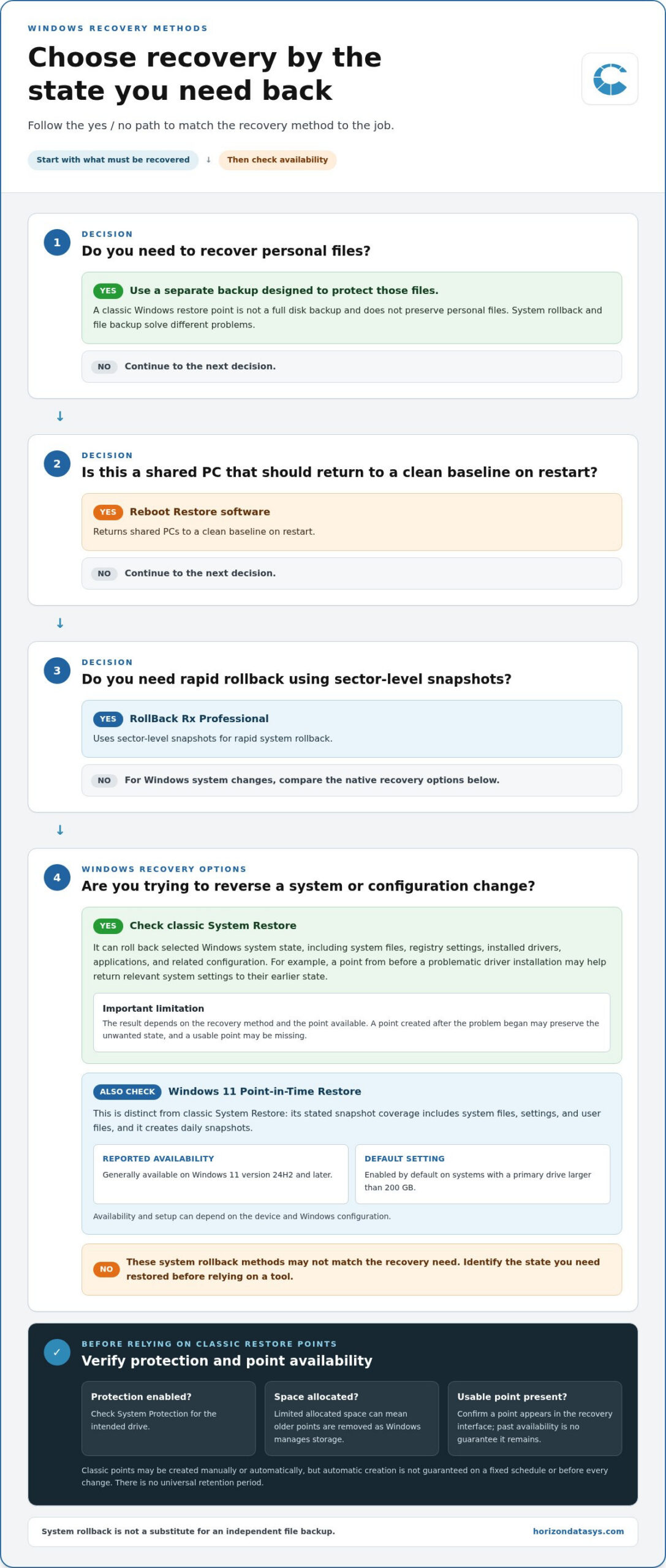
How to Choose Windows Restore Point Software for Your Recovery Needs
Start with the incident you need to recover from, not a feature list. The right restore point software for windows depends on the device, the system state you need back, and how quickly recovery must happen. Use this decision process to narrow the options:
- Identify the device. Is it a personal PC, a managed workstation, a server, or a shared computer used by many people? Shared endpoints often need consistent reset behavior, while individual workstations may need selectable rollback points.
- Define the failure scenario. A driver or configuration problem may call for ordinary system recovery. Repeated changes that require returning to a captured system state point toward snapshot-based rollback. Routine cleanup of public or shared PCs calls for baseline restoration.
- Set the recovery scope. Decide whether you need to reverse system changes, return the entire endpoint to a known state, or recover user files. These goals can require separate tools. System rollback shouldn’t replace independent data backups.
- Set the recovery-time expectation. Consider whether an administrator can tolerate a manual recovery process, needs rapid rollback, or wants a reset to occur automatically during normal restart routines.
Match the recovery method to the failure scenario
For an occasional problem after a recent configuration change, built-in Windows recovery may be a reasonable first option if the relevant feature is enabled and a suitable point exists. If operations require restoring a selected captured state after a disruptive change, compare snapshot-based recovery. For public or shared PCs, reboot-to-restore controls are designed to return devices to a defined baseline after restart. Each approach serves a different operational need.
Check operational requirements before adopting a tool
On organizational endpoints, assess more than recovery scope. Review automation, management scale, recovery access, and user disruption. A process that interrupts active work or depends on a user navigating recovery screens may not fit every environment. Confirm operating-system compatibility and deployment requirements in current product documentation before rollout. For technical context on how sector-level capture works, explore this guide to sector-level snapshot software.
Then match the approach to the fleet. RollBack Rx Professional uses sector-level snapshots for rapid system rollback, while Reboot Restore Enterprise provides centralized management for network environments. Reboot-to-restore is a baseline-control approach, not a substitute for preserving personal or business files. Keep independent backups aligned with the data your organization needs to recover.
Evaluate Windows endpoint recovery options against your recovery objectives and operational requirements.
How Horizon DataSys Supports Different Windows Recovery Needs
Once the recovery need is clear, match the tool to the job. Horizon DataSys offers two distinct approaches to Windows endpoint resilience: RollBack Rx Professional supports rapid rollback to a captured system state, while Reboot Restore software returns shared computers to a clean baseline on restart. Neither approach is a conventional file-backup service, and they aren’t interchangeable.
RollBack Rx Professional for captured-state rollback
RollBack Rx Professional captures lightweight, sector-level snapshots and enables rapid system rollback below the Windows operating system. It suits situations where an administrator needs to return a workstation to a previously captured state after a disruptive software or configuration change. Instead of relying only on a Windows System Restore point, an administrator can use these snapshots to roll the system back.
The choice isn’t about one method being universally better. Built-in System Restore may be sufficient for occasional troubleshooting when a suitable point is available. Snapshot-based recovery serves a different operational need: a deliberate return to a captured system state. For more detail on the approach and evaluation considerations, see this Windows system rollback software guide.
Reboot Restore for shared Windows computers
Shared computers often need consistency more than a menu of selectable recovery points. Reboot Restore software returns a computer to its defined clean baseline when it restarts, making it suited to environments where successive users need a predictable starting state. Reboot Restore Enterprise adds centralized management for network environments, helping administrators manage this baseline approach across connected endpoints.
This reset model differs from RollBack Rx Professional. Reboot-to-restore returns the device to its designated baseline, while snapshot-based rollback is intended to restore a selected captured state. The right fit depends on whether the primary need is recurring shared-PC cleanup or flexible rollback after a system change. In either case, plan separately to protect important user and business files.
For administrators comparing restore point software for windows, align the recovery layer with the expected incident and the way the device is used. Snapshot rollback and baseline restoration can help maintain system integrity, but they shouldn’t be treated as substitutes for independent file backups. Keeping those responsibilities distinct supports a more complete recovery plan.
Explore Horizon DataSys recovery software to compare the available approaches with your endpoint recovery requirements.
Turn Recovery Requirements Into a Tested Plan
Make recovery expectations explicit. Decide which endpoints need selectable rollback, which shared PCs should return to a standard baseline, and which files must remain recoverable independently. Document who initiates recovery, when it should happen, and how you’ll verify that the restored system is ready for use. A small, controlled test can reveal gaps between the plan and the process administrators and users can actually follow.
For organizations evaluating restore point software for windows, RollBack Rx Professional supports rapid rollback through sector-level snapshots, while Reboot Restore Enterprise provides centralized management for reboot-to-restore environments. These system recovery layers can complement a broader resilience plan, but they don’t replace independent file backups.
Explore the approach that aligns with your endpoint requirements: Explore Windows recovery software from Horizon DataSys. Set clear objectives and test the process to help your team move toward more predictable recovery.
Frequently Asked Questions
Can a Windows restore point recover my personal files?
Classic System Restore isn’t designed to recover personal documents, photos, or business files. If a file disappears, use a backup or another file-recovery method intended to protect that data. Windows 11 Point-in-Time Restore is a separate feature that can include user files in its snapshots on eligible systems, so check the feature’s availability and requirements for the specific PC. Don’t assume every Windows restore point covers personal files.
Why did Windows delete my restore points?
Windows may remove older points as it manages the disk space allocated to System Protection. Points can also be unavailable if protection settings change or are disabled for the drive. Check System Protection and its storage allocation, then confirm whether any points remain. If points disappear repeatedly, record the drive’s available space and configuration changes. That can help distinguish storage pressure from a settings change.
Is Windows 11 point-in-time restore the same as System Restore?
No. They’re separate Windows recovery features with different capture behavior and scope. Classic System Restore works with selected system state, while Point-in-Time Restore can include system files, settings, applications, and user files in its snapshots. The newer feature is generally available on Windows 11 version 24H2 and later, but eligibility and requirements can depend on the device. Check current Microsoft documentation before relying on it.
Can a restore point fix a failed Windows update?
It may help if the update caused a system problem and a usable restore point from before the issue exists. That isn’t guaranteed: the point may be missing, too recent, or unable to resolve the underlying cause. If Windows offers an update-specific recovery option, consider whether it addresses the failure more directly. For managed PCs, note the update, symptoms, and available recovery states before choosing a rollback.
Does Windows restore point software protect against ransomware?
Restore-point software isn’t a complete ransomware defense. Rolling a system back may help address some unwanted system changes, but it can’t guarantee that malware is removed or that encrypted or stolen data is recovered. Keep security controls and independent backups as separate parts of the protection plan. For shared computers, reboot-to-restore can return the system to a baseline after restart, but it shouldn’t be treated as protection for user files.
Can I use restore-point software on multiple Windows computers?
Yes, organizations can use Windows recovery software across multiple endpoints, with a product and management approach suited to the environment. For example, Reboot Restore Enterprise includes centralized management for network environments. Before deployment, map which devices need selectable system rollback and which need recurring baseline restoration, then review current product documentation for compatibility and deployment requirements. Run a controlled test so administrators can validate the recovery workflow before broader use.
Do I still need a backup if I use restore-point software?
Yes. Restore-point software and backups serve different recovery needs, so keep an independent backup strategy for important files. If a user deletes a project folder or a business document becomes corrupted, a system rollback may not provide the file-level recovery needed. Decide which data must be recoverable, how often it should be protected, and who is responsible for confirming that recovery works. Don’t treat restore software as a backup service.